
The Sister Jean bounce: An oral history of the Ramblers’ 2018 March Madness run
January 16, 2026
Share



It was the college basketball story the world needed when the 11th-seeded Loyola Ramblers made it to the Final Four during 2018’s March Madness alongside their then-98-year-old team chaplain, Sister Jean. The following is an account of the Ramblers’ NCAA Tournament run that catapulted Sister Jean Dolores Schmidt, BVM, to a national—and international (as she liked to remind people)—stage, from the people who were there.
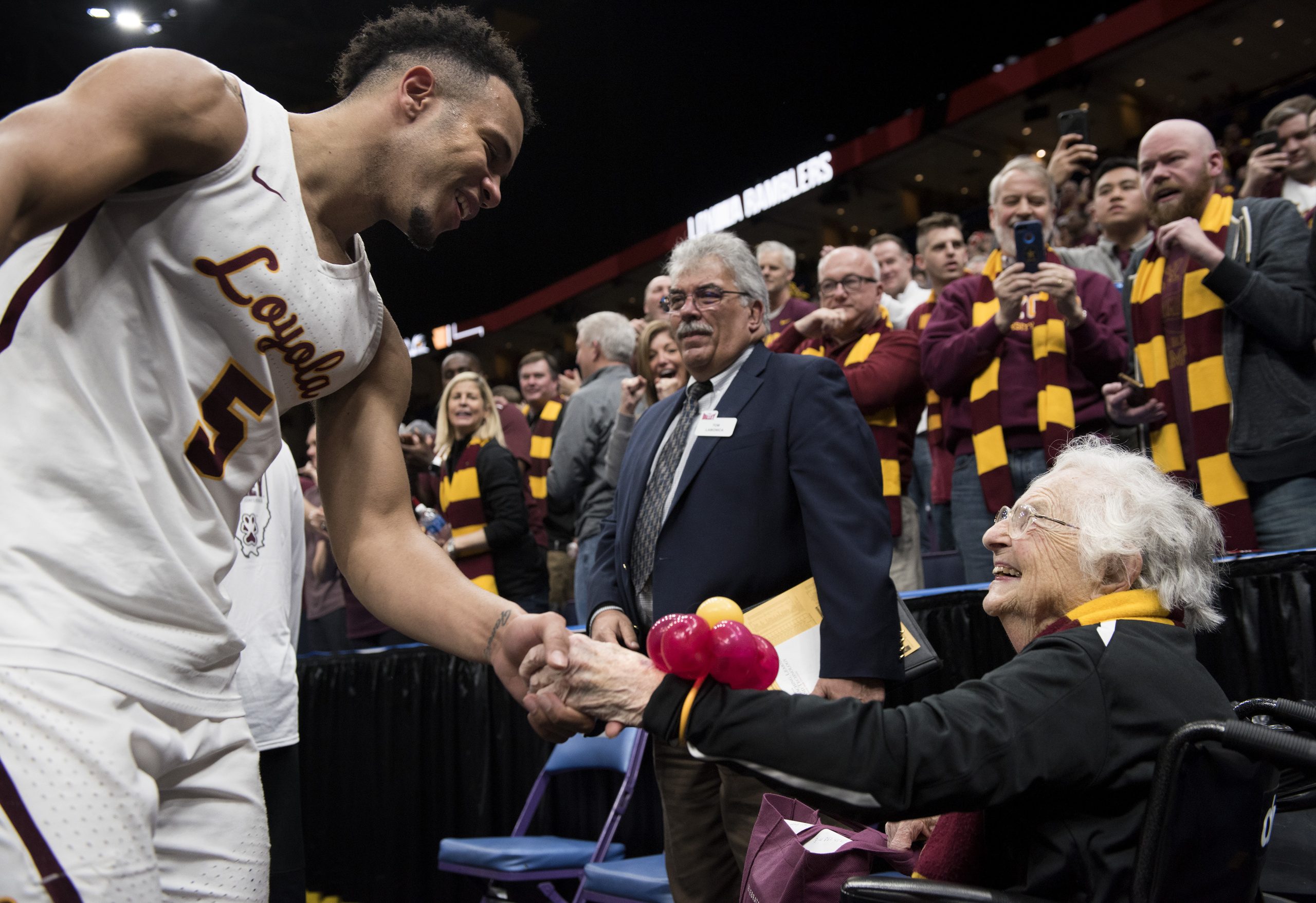
During the regular season, the Ramblers men’s basketball team saw a series of wins that drew increasingly large crowds, culminating in Gentile Arena’s first sellout in years.
Drew Valentine, Loyola head coach (assistant coach of the 2018 Loyola team): Even before the run, it was a special group that believed in the culture Coach Porter Moser created. Those guys were just so connected; they were real brothers…There was just a really selfless attitude among the team. They represented the Jesuit mantra, “men and women for others, to the fullest.”
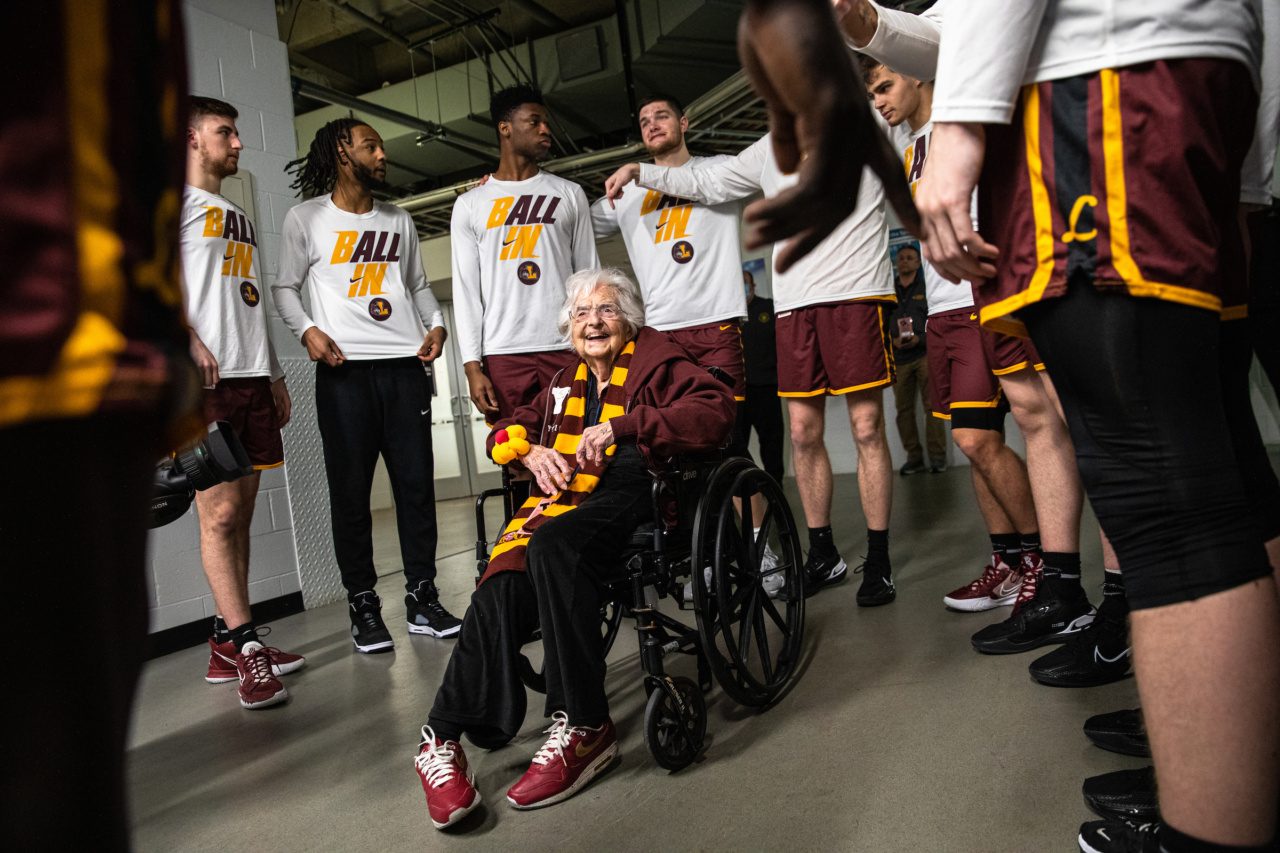
Steve Watson, director of Athletics: The team didn’t start practice without having their hands blessed by Sister Jean. They didn’t take the court for a game without a prayer with Sister Jean….The guys all had different relationships with Sister Jean, some much closer than others. But you could see these 19-, 20-, 21-year-olds had a bond and a friendship with an old nun they could talk to.
Donte Ingram, guard/forward (BASC ’18): As far as her pre-game prayers, she kind of caught everybody off guard initially. If you were to hear that first prayer, you wouldn’t think that you were going to get a scouting report. But the more you got to know her through her prayers and her emails, the more you got to see how much of a fan and student of the game she was.
Clayton Custer, guard (BA ’18, MBA ’19): I think the pregame prayers instilled a little bit of extra confidence in us. Sister Jean’s presence gave us a boost of confidence that we really could do it.
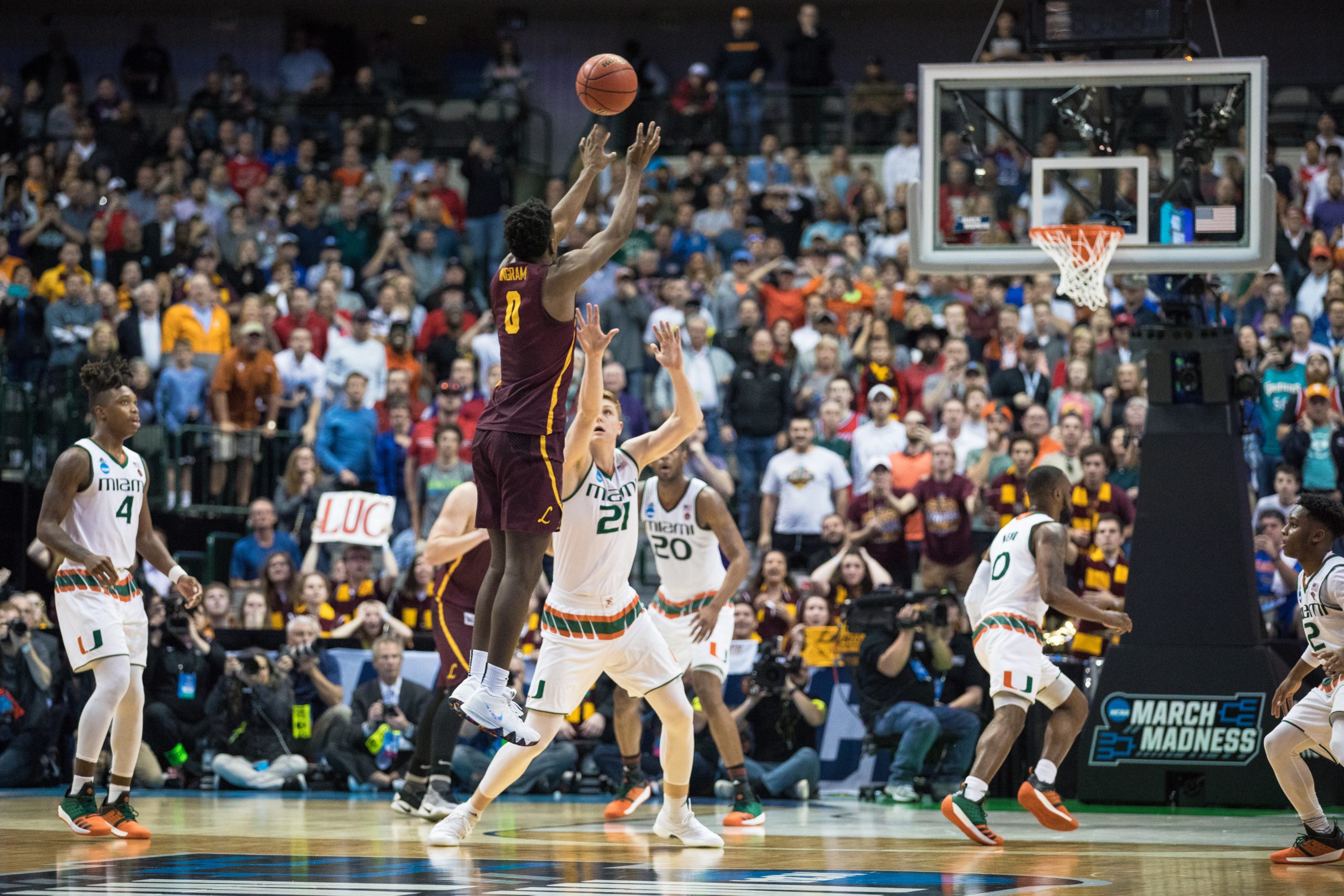
The bid the Ramblers longed for came in March, and the team headed to Dallas, Texas, as the NCAA Tournament kicked off. The Ramblers first played Miami and won 64-62, with a dramatic last-second shot by Donte Ingram.
Porter Moser, former head coach: The whole phenomenon [of Sister Jean as a celebrity] started in the Miami game when Donte Ingram hit the game-winning shot.
Ingram: I get chills every time I think about that moment just because there were so many ups and downs…I always tell people I almost missed the chance to take the shot because the free throw that Lonnie Walker missed bounced around. When I jumped, it bounced again, and I fell. But Ben Richardson covered me. So that was the first part: that he had my back. Then, after Ben got that rebound, I got up. Honestly the team kind of felt comfortable because we had run through those situations: being down one, being down two, being down three. So we knew what to do, which is why Coach didn’t call a time out. When I saw that I was the trailer and I had an opening, I just called to Marques Townes really loud. And when I shot it, the shot felt really good, so I was running to half-court before it even went in.
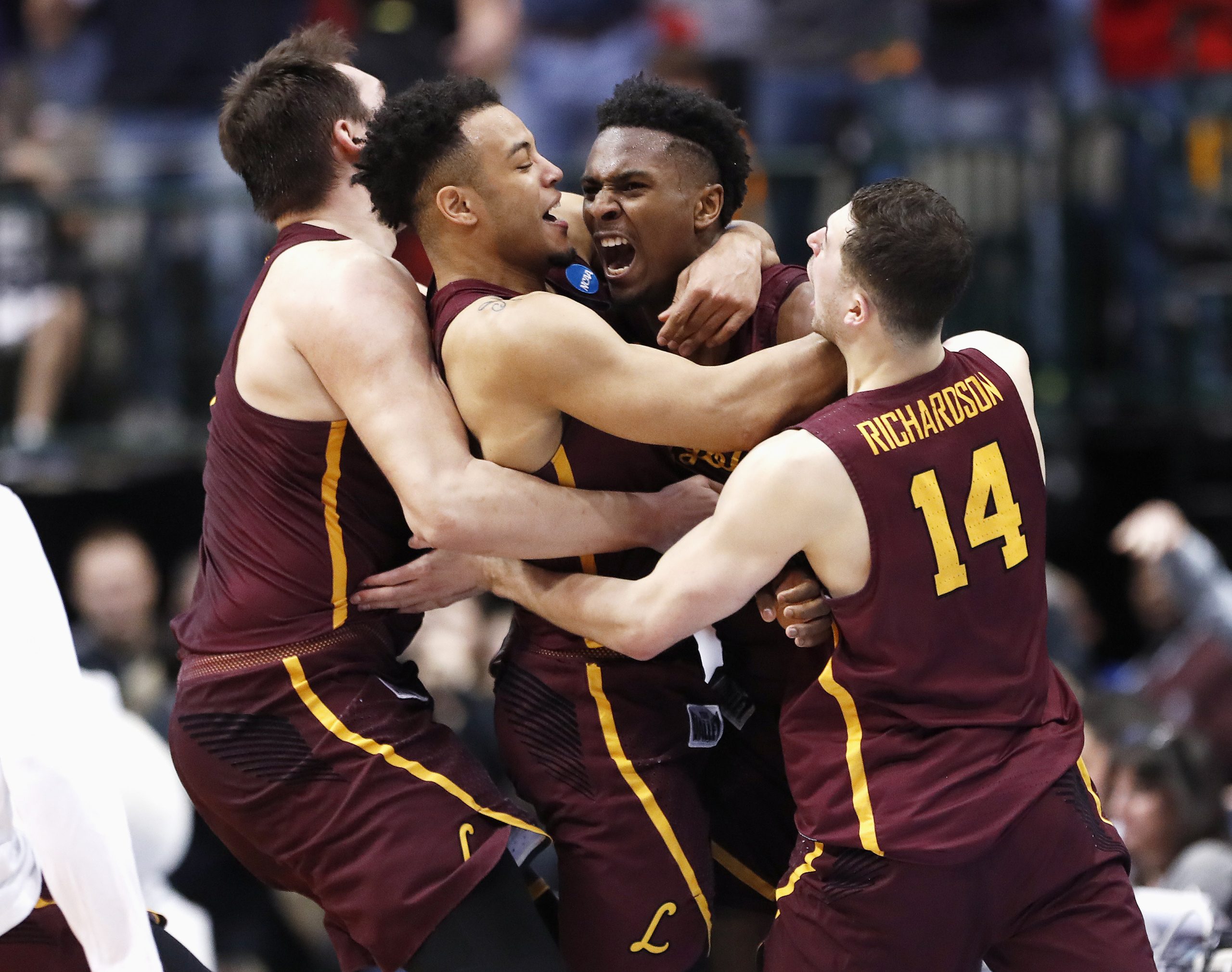
Valentine: When Donte Ingram hit that shot, I blacked out. I sprinted across the court and forgot that I was a coach for a second.
Ingram: I gave [Sister Jean] a big hug, and she was just saying, “Congratulations, what a moment,” and we just soaked that in together. It capped off a great game — being able to experience that excitement with her.
Moser: The next 48 hours was pandemonium. It kind of took the spotlight off our guys that everybody was talking about Sister Jean while we were getting ready to play Tennessee. The media access she got was remarkable.

Next, the Ramblers took on Tennessee and won the game 63-62 in an exciting buzzer beater with 3.6 seconds left to advance to the Sweet 16.
Custer: That was probably the best individual moment of my basketball career. We were down one… and Coach gave me an opportunity to make a play, and I got downhill and created a little space and was able to get the shot off. Did I think it was going to go in? It didn’t feel good coming off my hand at all, but I think Sister Jean might’ve had a little bit to say about that ball getting the bounce that it got. And I know that people after the fact called it Sister Jean’s Miracle Bounce, which was pretty awesome. It’s hard to say that Sister Jean didn’t have something to do with that ball going in. We had our little celebration on the court as a team, but then, as we’re walking off the court, Sister Jean was over in the corner near the tunnel and we were all giving her hugs after the game—we did that every game for the most part…and she just said, “I’m so proud of you.” She was always such a positive figure for all of us, and it was just a really special moment that I’ll cherish for the rest of my life.
That was probably the best individual moment of my basketball career… Sister Jean might’ve had a little bit to say about that ball getting the bounce that it got.”
— Clayton Custer, Former guard
After the Ramblers’ wins against Miami and Tennessee, the media became increasingly interested in Sister Jean, and Sister Jean met the moment with her signature energy.
Bill Behrns, former assistant athletic director for communications: Sister really transcended sports, and that’s what made the story become a Good Morning America, Today Show, Access Hollywood story. If you would have told me before the season started that we would have had appearances on those shows, I would have told you that you were absolutely out of your mind.
Thomas Hitcho (PhD ’96): She never said no, regardless of if she was tired, if it was late. She was a person for others, always accommodating.
Behrns: We had to save her from herself because she would have said yes to everything because that’s how Sister was. She didn’t want to disappoint people, and if people wanted to ask her questions, she was more than happy to talk to people.
Sister really transcended sports, and that’s what made the story become a Good Morning America, Today Show, Access Hollywood story.
— Bill Behrns, former assistant athletic director for communications
The Ramblers traveled to Atlanta, Georgia, for the next two games. A dedicated team helped handle Sister Jean’s logistics as the Ramblers progressed in the tournament.
Moser: The NCAA has a big charter plane. It was one of those that are in the private terminal, where they wheel up a set of steps and you’ve got to go all the way up the steps to the plane. We’re like, “How are we getting Sister up there?” And I’ll never forget it: It reminded me of crowd surfing. Our guys, we lifted Sister up, we crowdsurfed her up all the stairs into the plane.
Hitcho: Traveling on the team charter, getting her on and off the plane, getting her from the plane to the hotel, from the hotel to the arena: There’s a lot of logistics involved. A lot of people that should get credit for that work. It was a team effort behind the scenes… No matter where we went—Dallas, Atlanta, San Antonio, arenas—the people were so accommodating and helpful. Whatever they could do to help Sister, which made it a lot easier.
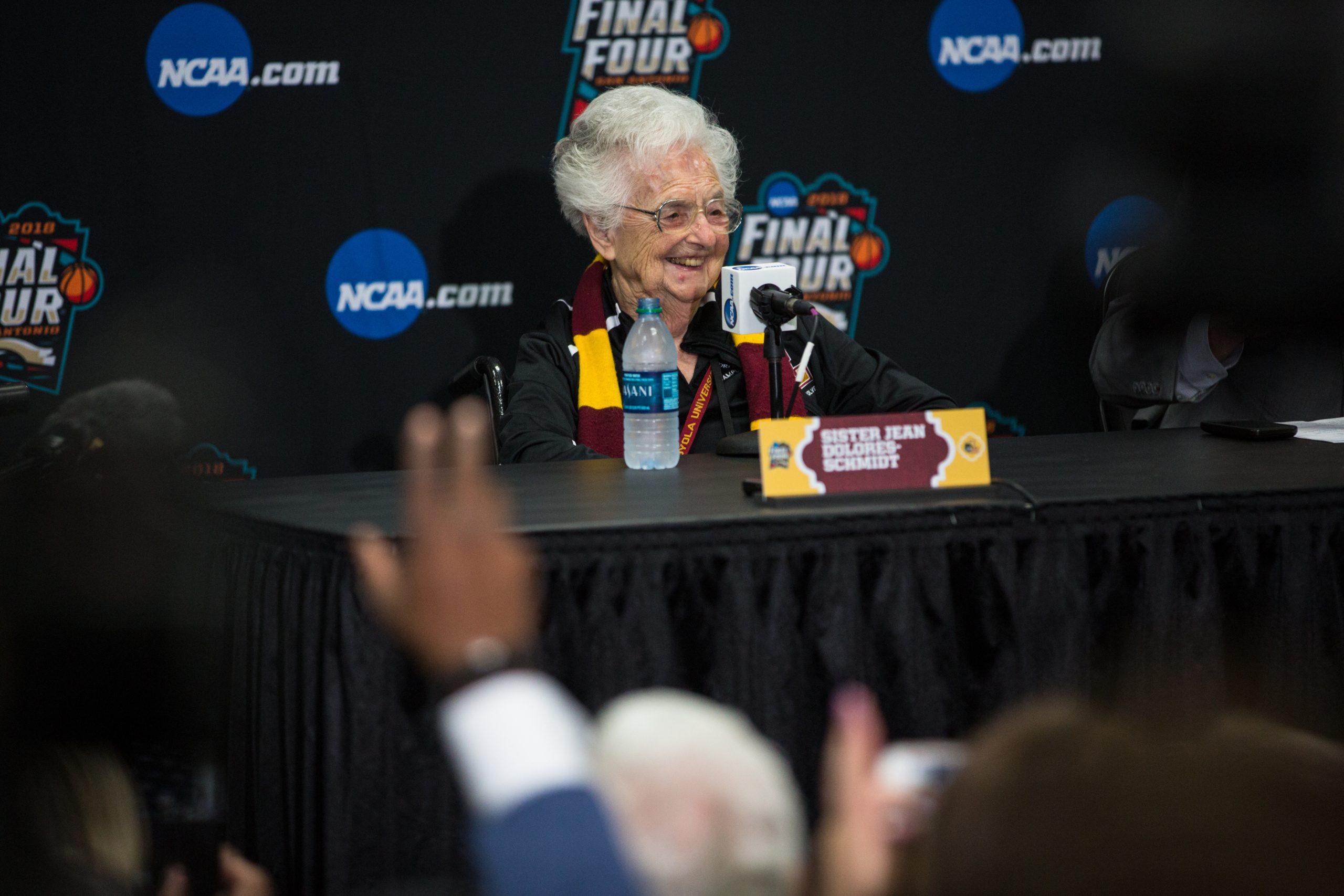
Once she arrived in Atlanta, the media attention on Sister Jean intensified.
Kevin Newman, police lieutenant at Loyola: I was with her almost the entire trip to Atlanta. We would take some breaks, but we were pretty much always around. And that next morning it really did start out as a big interview day in the team hotel. She did an interview promo for the NCAA where they were doing a feature for the broadcast. She was then on a CNN morning show filmed in the hotel.
Watson: We had a great security detail, but I can just remember that, at one point, we had seven security guys, and I’m like, “What are we doing? Why do we need seven people?” And then you see the massive amount of people that wanted a piece of her, and it’s like, “Is seven going to be enough?”
Newman: I think most people would be overwhelmed, but we did not see that from her. She would talk to each person as long as she possibly could. It quickly became clear that one of the roles we would have to play is the role of saying “No,” not to her, but to others…Because Sister would stand there and talk to everyone for as long as they wanted, and she loved doing that.
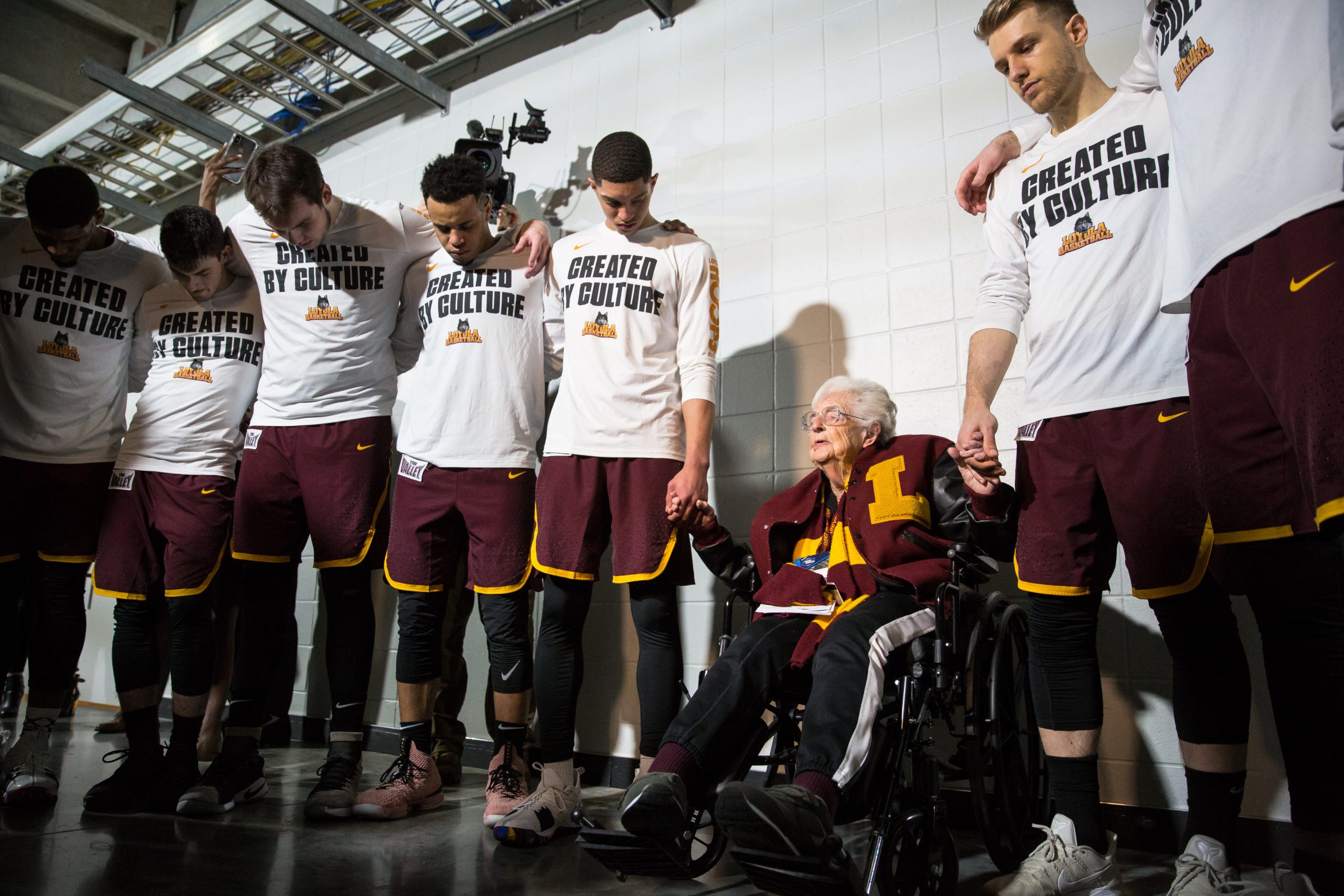
Giving media interviews and taking selfies was just one part of Sister Jean’s role. During games, she wanted to be there for the players, and she watched the play intently.
Watson: She was a part of the team and going on the ride with them, but she had a job to do also. The media got to see her and talk to her, and everybody got to know her. But at the same time, don’t mess with her during a game, don’t try to have a conversation with her during the game, because she’ll snap at you. Because she’s focused and preparing for the pregame prayers. She wasn’t saying two Hail Marys, those prayers took time and effort and they were scripted…Looking after those guys and being there for them was part of her job.
Newman: During the game, the team was running the stat sheets up to her so that she could review the statistics of the players in the middle of the game and see how they were doing. A lot of people say, “She likes basketball.” But there’s not a lot of fans that get the official score sheet at a timeout.
Custer: For all of us on the team, it was a holistic relationship, with a personal side. She was there for us academically if we needed help or words of encouragement. And then, obviously, she also was very in tune with basketball. She knew exactly what was going on in the program. She even knew the other teams, and she had the scouting reports. So she was involved in a lot of different aspects of our lives.
The more you got to know her through her prayers and her emails, the more you got to see how much of a fan and student of the game she was.
— Donte Ingram, Former guard/forward
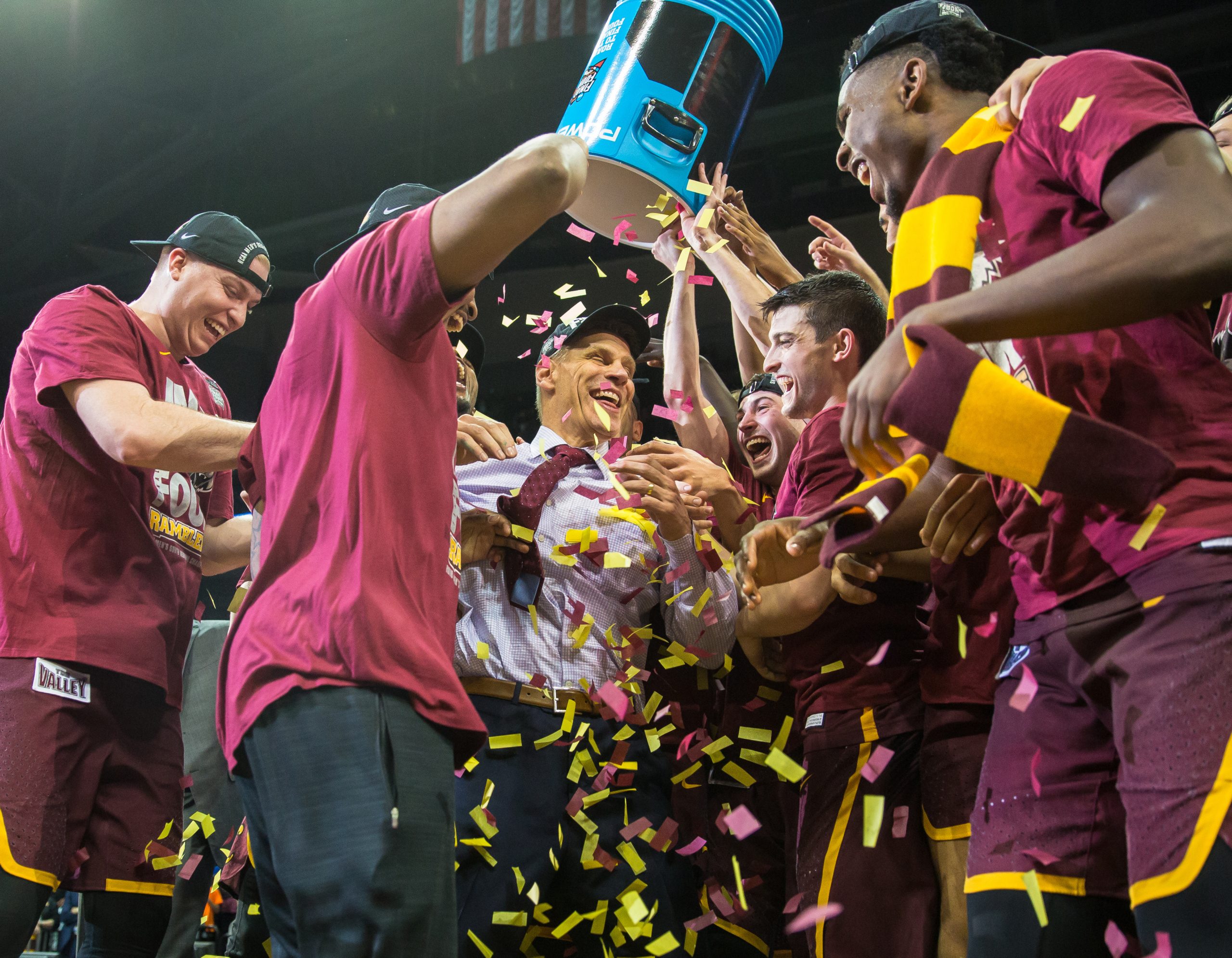
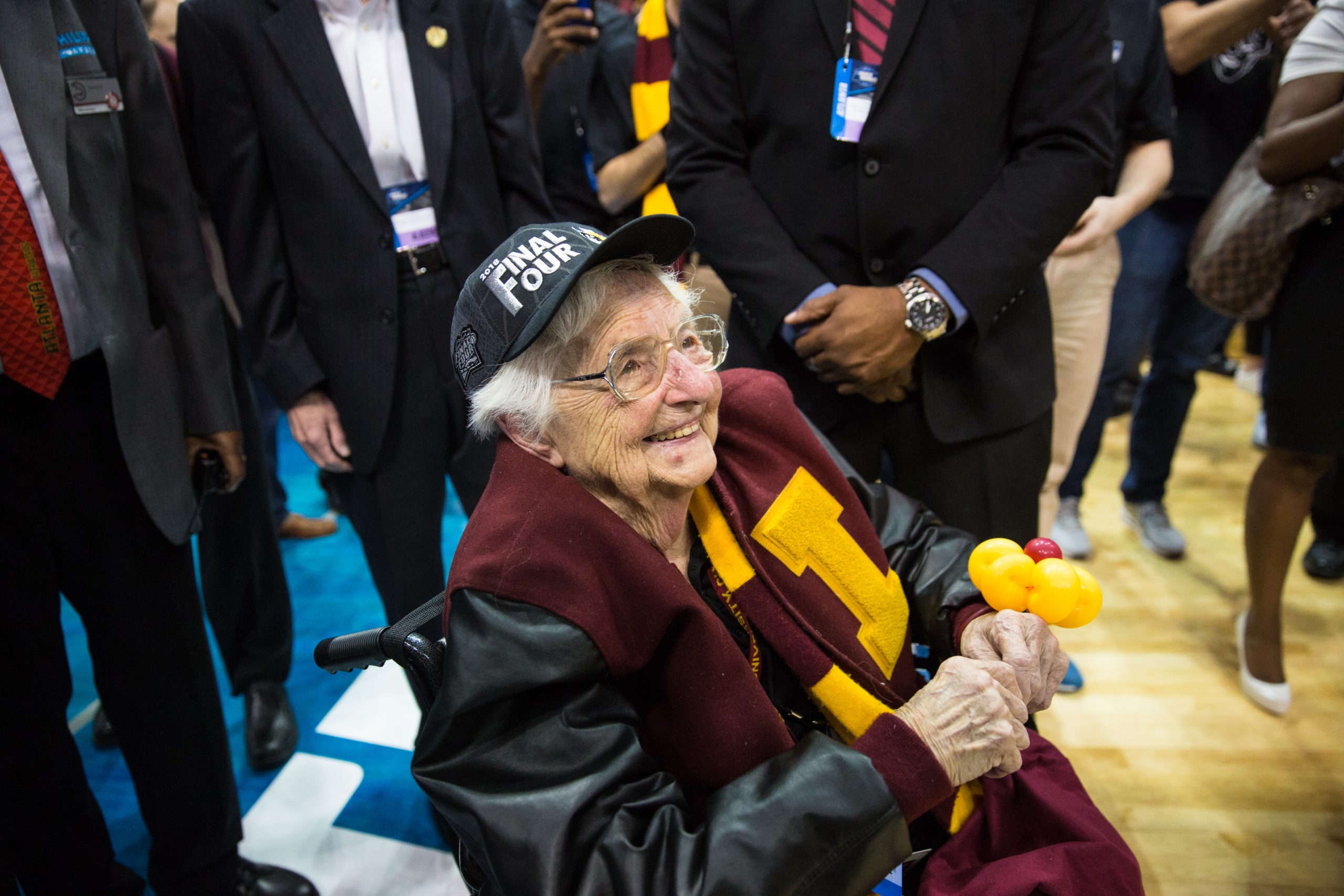
In Atlanta, the Ramblers beat Nevada 69–68 and Kansas State 78–62 to advance to the Final Four.
Custer: We had a relationship where we could joke around with each other a little bit. After one game [against Nevada to advance to the Elite Eight], while we were in the locker room, I was like, “We broke your bracket,” because we were able to go further than she predicted. And Sister Jean said, “Keep breaking it.”
Lucas Williamson (BA ’21): It was cool to see…how many people showed up for us in the tournament. Like when we went to Atlanta, how many people had the scarves, how many people showed up with maroon and gold. You look at all these big universities during March Madness, and a huge amount of alumni show up for their games. And we were right on par with everybody there. Everybody calls us a Cinderella team. I don’t necessarily love that term because Cinderella is like, clock strikes midnight, you’re not supposed to be there, right? We were one of the best defensive teams in the country that year. We were one of the best teams in the country that year…I felt like we were right there and ready to fight anybody.
Valentine: What I’ll remember is just how that team did an amazing job of living in the moment, whatever moment presented itself, whether it was going into film sessions to do scouting or doing shoots for CBS, or whatever it might be, those guys had fun with it, and they embraced the moment, and they weren’t too cool. They were humble but enjoying every moment.
After clinching a spot in the Final Four, students gave the Ramblers a spirited welcome back to campus before they left for San Antonio.
Behrns: When we got back from Atlanta after we had beaten Kansas State to go to the Final Four, they had a rally in Gentile. The arena was packed with students, with fans, with alumni. I remember being a couple of steps behind Sister Jean as she got wheeled into Gentile from the tunnel, and as soon as she became visible to the crowd, I just remember that place going absolutely bonkers. When Sister Jean got wheeled in, it had to have been what it was like when the Beatles were at the height of their rock stardom in the 1960s.
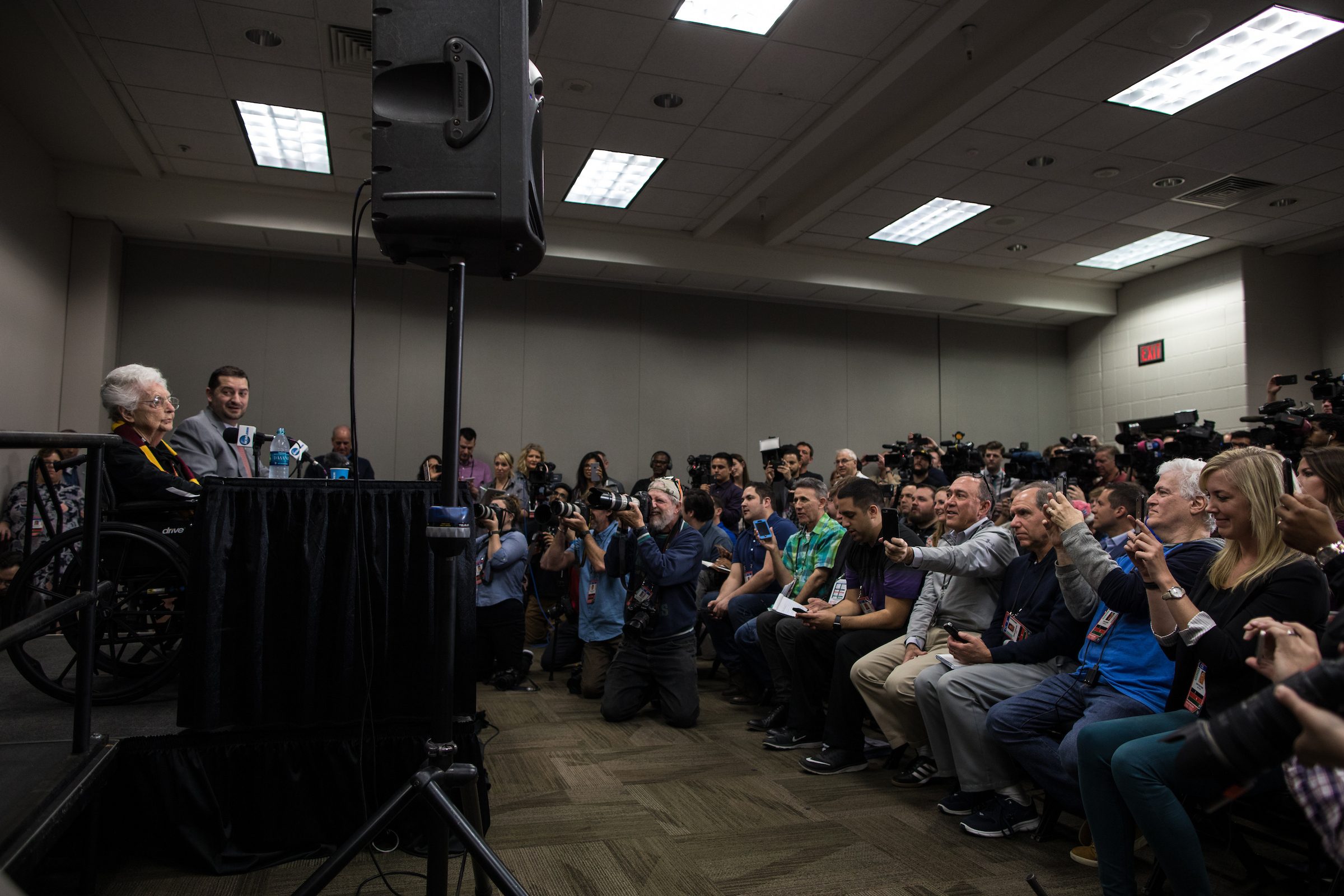
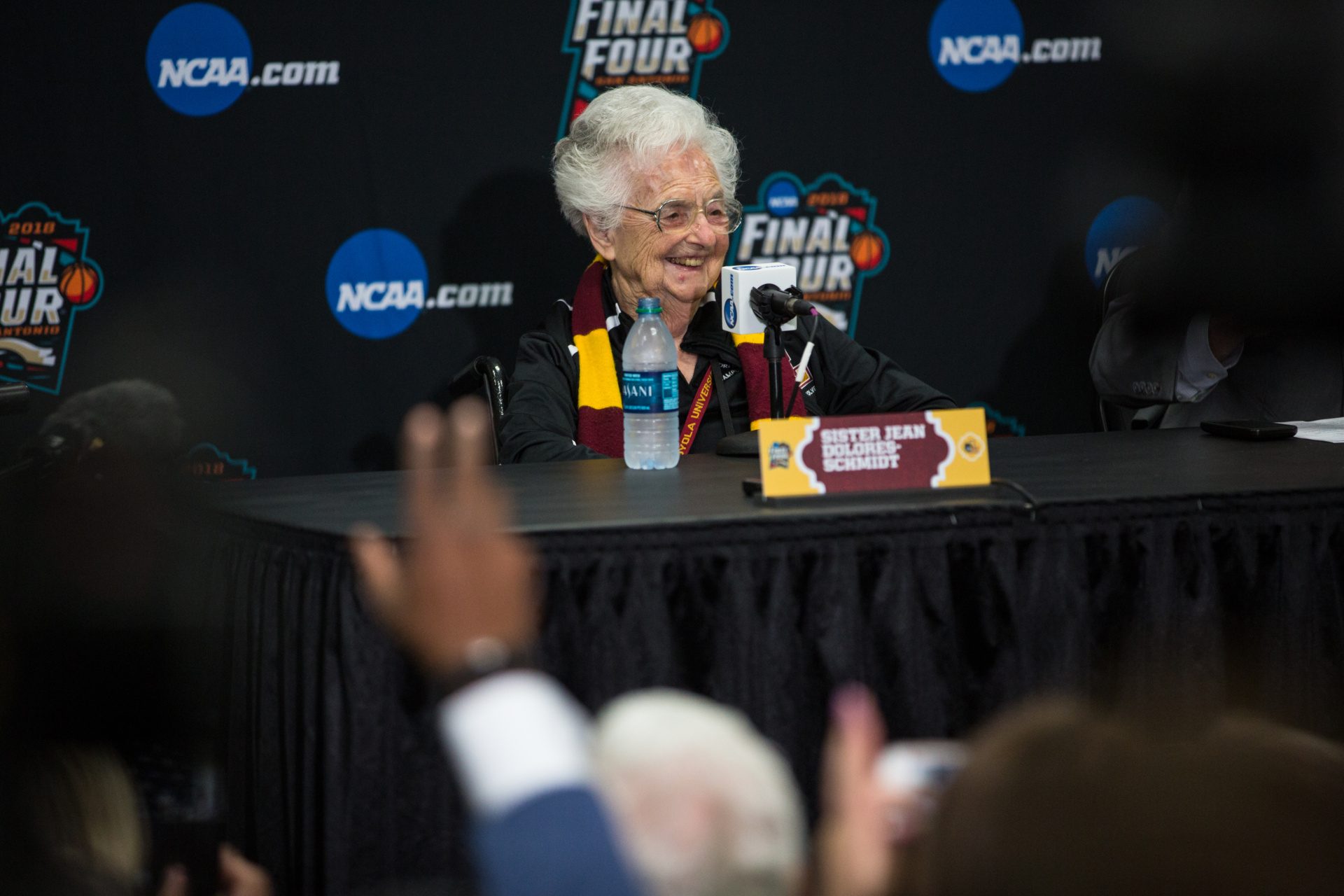
Valentine: Sister Jean had her own press conference… And that’s just unprecedented. I don’t ever remember somebody that was a member of the team that was not actually out there on the floor during the Final Four holding their own press conference… I walked into the Alamo Dome, into her press conference, and it was just insane. Just seeing the charisma, the wit, the energy she handled that with was a once-in-a-lifetime moment.
Williamson: That’s the national story right there. Like, yes, we are winning. Yes, we are a good team. Yes, we made it to the Final Four, which doesn’t happen a lot as an 11 seed. And we also have Sister Jean. And she’s the story.
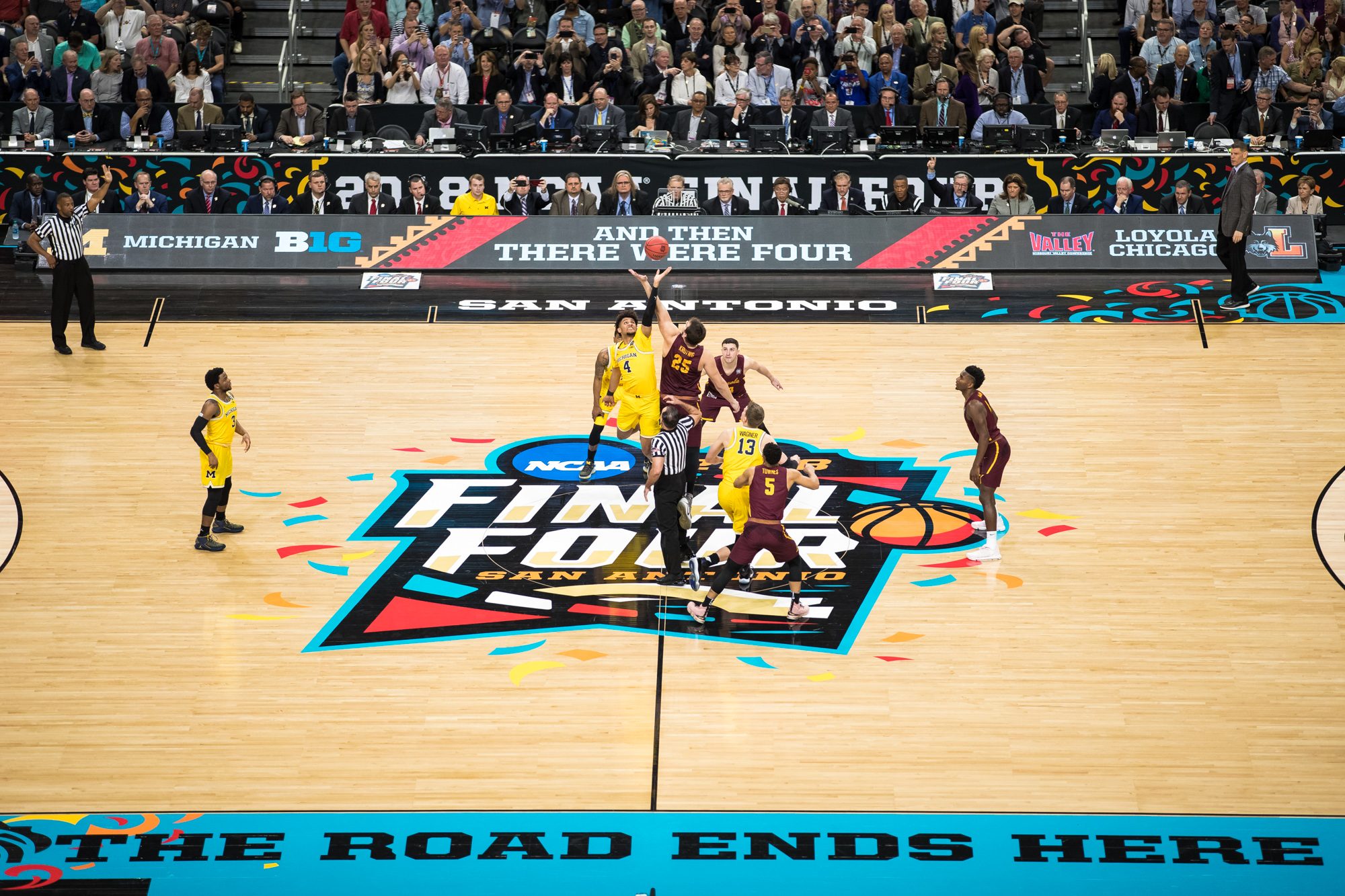
The Ramblers experienced a whirlwind end to the Cinderella run in San Antonio against Michigan, losing 57–69.
Hitcho: I remember we were in San Antonio. It was Good Friday. We were trying to get her over to a Good Friday service. She did prayer before the game, saying, “Hey, Michigan is just another team. You could do it. You could beat them. Don’t get startled or scared by the name Michigan.”
Williamson: I remember subbing in and looking up and seeing… people, as far as I could see. It was just like a blur, 80,000 people in one venue to watch a basketball game.
Hitcho: Halftime we were up, and then unfortunately they took over the second half and played well.
Williamson: They hit a whole bunch of crazy shots, and we didn’t make enough plays.
Hitcho: We had to get [Sister Jean] down to the court. She greeted the team as they came off.
Custer: She pulled all of us aside and told us she was there to support us, and she consoled us. She told us that we had nothing to be ashamed of and reminded us how much we impacted the university, even the country, and the joy we brought to people by living out the Cinderella underdog story. She was just so proud of us, and it meant a lot that she was there. She was there with us through the good times, and she was also there for us when things didn’t go our way.
Behrns: She brought along people who weren’t normally college basketball fans, and she made them become Loyola fans for that three-week period in time. She really transcended sport. … Sister and our team were just that thing that made you feel good about college athletics. I think that’s why people gravitated toward her story so much.