

A Loyola professor was diagnosed with cancer. His doctor? A fellow Rambler
November 2, 2026
Share


Gerald Buldak was commuting to his job on Loyola’s Lake Shore Campus early on a Wednesday morning in 2024 when he started seeing double.
He pulled over, texted his wife to pick him up, and together they headed to the emergency room.
“They wound up running some tests on me and by 9 o’clock that morning, they were dropping the bomb on me that I had cancer,” Buldak said.
That day, he was diagnosed with Stage 4 nasopharyngeal carcinoma, a rare, aggressive cancer that forms at the back of the throat. An immunology instructor in the Department of Biology, Buldak was no stranger to cancer. He performed postdoctoral research on cancer genetics at Loyola before taking on the undergraduate immunology courses he teaches today.
“Getting cancer later on down the road and knowing something about what’s going on doesn’t make the process easier when you’re going through it,” Buldak said.
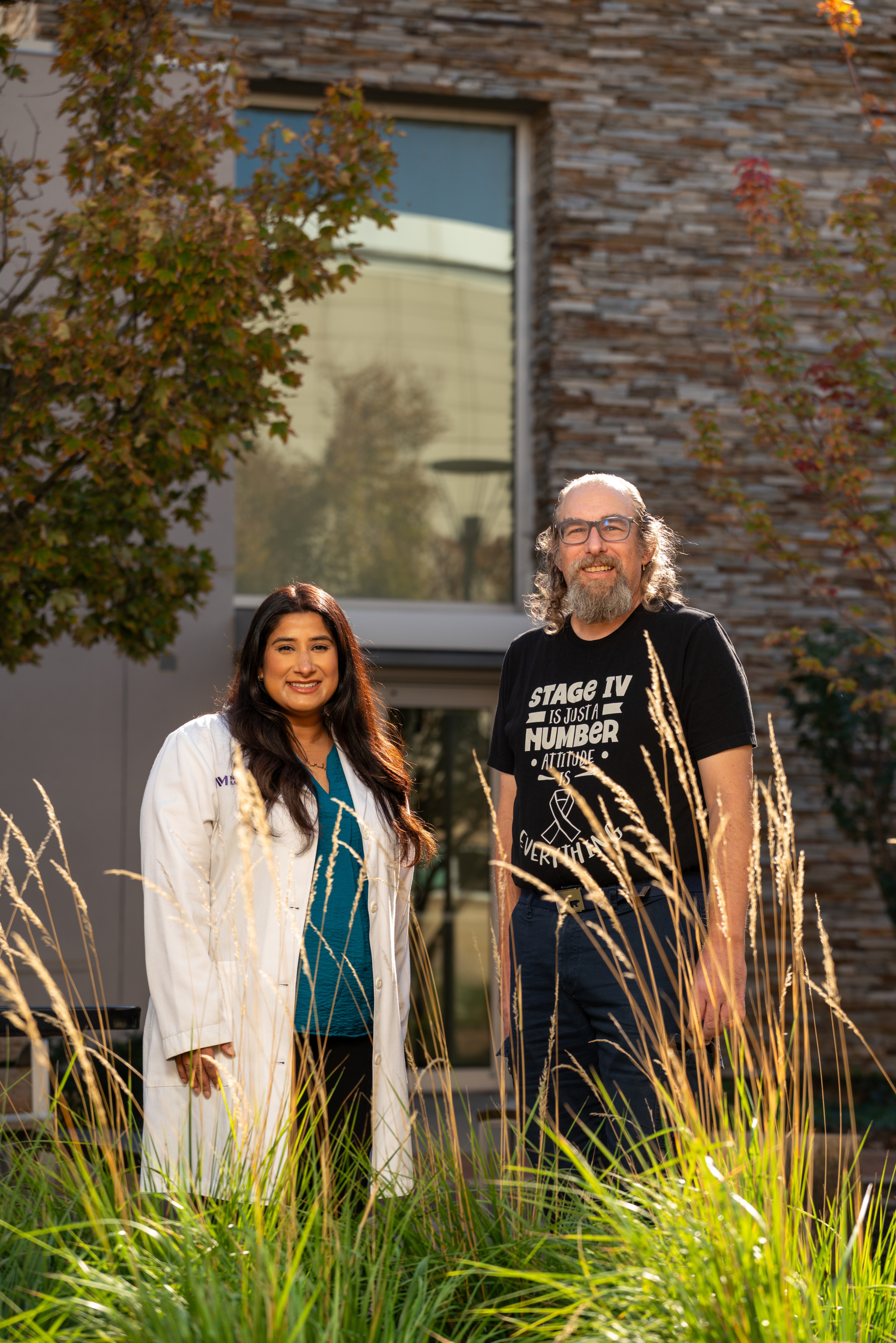
Buldak soon transferred his treatment—a grueling mix of chemotherapy and radiation—closer to home, at Northwestern Medicine Cancer Center Warrenville, where he would connect with Nida Hussain (BS ’09), a hematologist and medical oncologist—and a Loyola alum—who led his care.
“That sense of cura personalis was there at the forefront in the way she treated me,” Buldak said.
I wasn't just numbers on a chart to her. She treated me like a human. I think that lent a lot to her approach, just this intrinsic sense of empathy that she had, that she actually listened and paid attention to what I was saying.
— Gerald Buldak, immunology instructor, Department of Biology
The two didn’t realize their mutual connection to Loyola until partway through Buldak’s treatment, when he arrived to an appointment wearing a Loyola fleece jacket. While Hussain and Buldak didn’t overlap at Loyola (she was pursuing her undergraduate degree when he was doing postdoctoral research), the two bonded over their shared experiences on the pre-med track.
“It really is our undergraduate professors that help shape your capacity to digest a lot of big scientific information,” Hussain said. “The professors I interacted with, particularly those who teach pre-med students—the physics, organic chemistry, biology—I really think those professors, as a whole, understand the responsibility that they carry of building the foundation for people who then go out and become the health care workers of the country.”
As his treatment progressed through scans, radiation therapy, chemotherapy, and biopsies, Hussain remained a constant positive force.
“Nida was the rock. All I had to do was say something and she would go and advocate for me,” he said.
Likewise, Hussain, a new parent at the time, was inspired by Buldak’s commitment to his family.
“He made such an effort to make sure that his children’s lives were not impacted by his cancer diagnosis,” she said. “He probably doesn’t even know it, but that was incredibly impactful for me because it just shows you not only what a parent is willing to go through or has to go through, but how they can still prioritize their family and their children.”
Luckily for Buldak, the treatment was successful. He still gets scans, but as of November 2024, he remains in remission. The experience—and the relationship he developed with Hussain over the course of his treatment—has stuck with him.
“I wasn’t just numbers on a chart to her. She treated me like a human,” Buldak said. “I think that lent a lot to her approach, just this intrinsic sense of empathy that she had, that she actually listened and paid attention to what I was saying.”
For Hussain, being able to treat a patient like Buldak strengthened her sense of purpose she found in her role.
“When you do this work day in and day out, you don’t even sometimes realize the impact you’re having on people,” Hussain said. “This is what I’m meant to do.”


