

With tours of Google, LinkedIn, and more, Loyola prepares students for jobs
October 22, 2026
Share


“It’s been mind-blowing,” Eyan Edwards (BS ’28) said, just before leaving an early October career tour of Google’s Midwest headquarters in Chicago’s Fulton Market District. “Coming here to see this tech giant and how they operate and the people that work here—it’s given me a leg up on what to expect after graduating.”
Edwards is a third-year engineering student with a focus on computer science and plans to pursue a law degree after graduation. One day, he’d like to work in patent litigation, perhaps for a large tech company, like Google, Tesla, or Amazon.
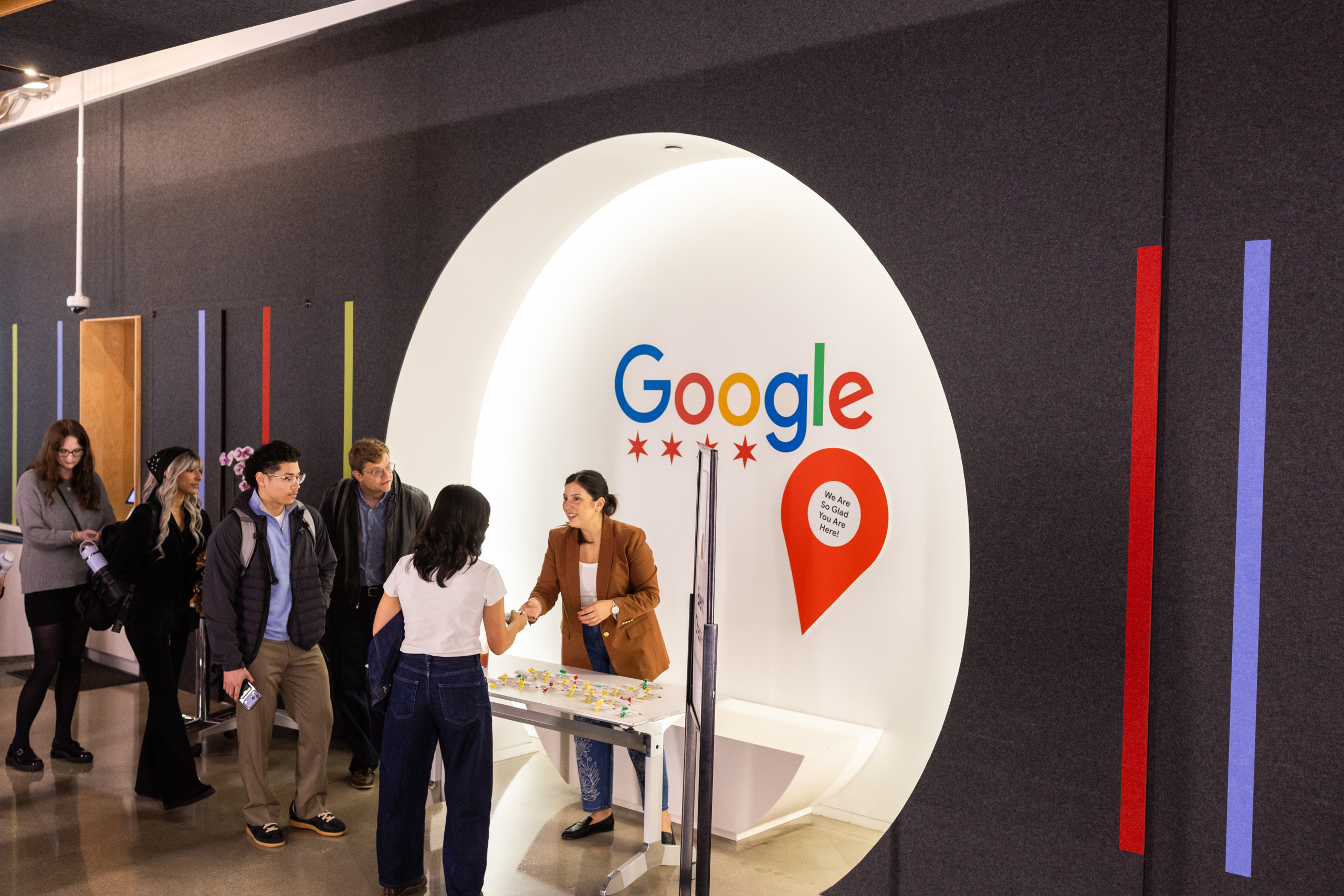
During the half-day office tour—one of more than 10 organized each year by Loyola University Chicago’s Career Services department—he joined roughly 30 other Loyola students and recent alums for a rare, behind-the-scenes glimpse of life at Google.
Part of Edwards’s excitement arose from seeing the office itself—a 10-story former meatpacking facility, seven of the floors occupied by Google, with a blues-themed cafe; microkitchens stocked with fruit and seltzers; arcade-style games and pinball machines; a fitness center; a recording studio; a tea-delivery robot; local street art splashed across the walls; and perhaps most notably, a CTA subway car perched on the roof and offering a breathtaking view of the Chicago skyline.
But the bigger thrill, Edwards told me, was the facetime he got with employees.
“I was talking with George Botros Boles [a Google software engineer], and he was telling me a background in computer engineering sets you up kind of ahead of the curve,” Edwards said. “He’s like, ‘What do you guys work on?’ I told him, specifically, about our work with embedded circuit design. He said that kind of knowledge and expertise … makes you stand out to employers in the field.”
These are the kind of professional connections—and resume-building insights—the career tours, launched in 2024, are designed to foster, says Genevieve Harclerode, assistant vice president for Career Services.
Loyola partners with Northwestern Medicine, United Airlines, CBS, LinkedIn, and more than a dozen other Chicago-based employers to offer the tours, which typically include employee stories and career tips, peer networking opportunities, and Q&A sessions. In recent years, students have bumped into NBC 5 News Anchor and 2026 Commencement speaker Lou Canellis (BA ’87), peeked in on a WGN-TV cooking segment with celebrity chef Rick Bayless, and visited the team office of the Chicago Blackhawks.
The tours, Harclerode said, sit inside a discipline-specific career community model that helps students explore career options, schedule appointments with advisers, refine their resumes and interview skills, and attend career fairs and workshops with a cohort of students who share their professional goals.
“Part of the intention behind this is not just for the student to experience this as an individual, but that they have an opportunity to meet other students who share some of the same career interests as them, and experience an immersive event together,” Harclerode said. “And one of the things that is such a huge advantage for a school like Loyola is that we have all these amazing world-class organizations right in our backyard.”

Navigating a tight job market
If Edwards’ post-law school career plans seem far off, Harclerode insists that they’re not. Early career exploration is wise, she said, particularly in light of a cooling job market.
“Day to day, we see students who are really excited about their career paths; they’re motivated to do good work in the community,” she said. “On the other hand, our students who are getting ready to graduate are entering a time of tremendous uncertainty. We know that this is a more challenging job market.”
Job postings for entry-level roles in the U.S. dipped 35 percent since 2023, according to the research firm Revelio Labs, and an August revision to a study by Stanford Digital Economy Lab found that job growth for workers ages 22 to 25 in jobs most vulnerable to AI is 20 percent below the growth rate for jobs least exposed to AI.
These trends—compounded by employers’ reluctance to hire in a period of economic uncertainty—have made it especially important for students to get early exposure to employers, not just to boost their professional confidence, but to gain first-hand insights they can share throughout their job search.
“What we’re trying to do when you look at something like career communities or career tours is to create touchstones for students to be able to say, ‘I tried something, I clarified my interest, I can articulate to an employer that this is the next thing that I want to do, and I know why,’” Harclerode said.
Design thinking
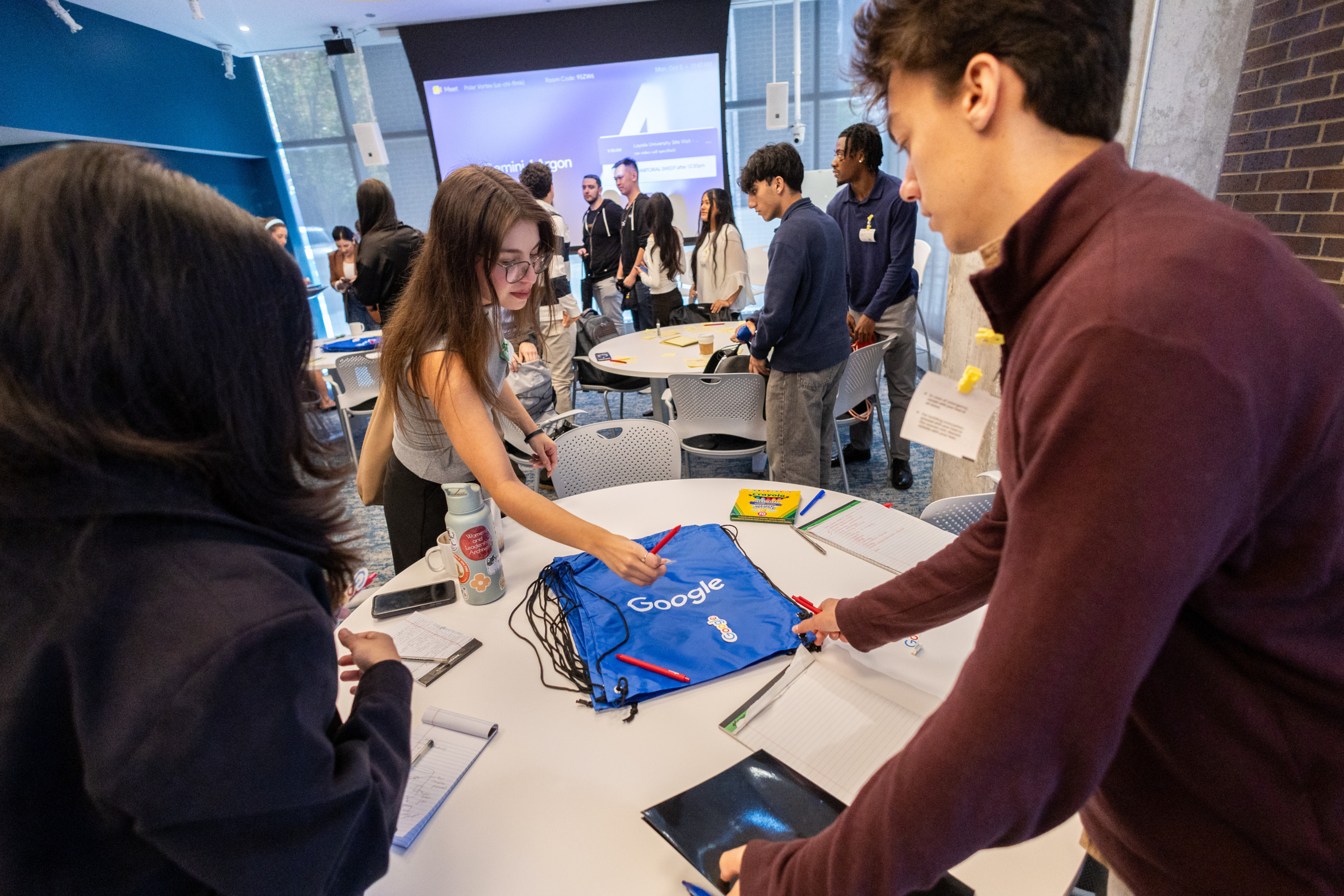
That message appeared to resonate with Loyola students who were ready with questions as Jessica Holberg, a strategy and operations manager for Google.org, the company’s philanthropic and charitable arm, led them through a packed itinerary that included an office walk-through, a small group design thinking exercise, lunch, and a panel discussion.
After introducing students to Google’s mission and core values, Holberg offered a crash course in design thinking, a product-development framework that companies like Google, IDEO, and IBM use to create products and services. The approach begins by defining a user or community problem, then moves through stages of persona development, problem definition, ideation, and prototyping and testing—the premise being that empathizing with a user’s needs will yield the best products and media campaigns.
Lucca Castrese (BBA ’28), an international finance major in the Quinlan School of Business, who grew up in São Paulo, Brazil, worked with his partner Maya Alexa (BA ’28), an advertising public relations major in the School of Communication, to create a concept for a GPS- and AI-enabled tracking system for ranchers to verify the provenance of the cattle they buy. The idea grew out of an internship Castrese had at a Brazilian-based venture capital firm over the summer.
The design thinking exercise—and the experience as a whole—left him convinced of the value of clear, succinct communication in the workplace. He plans to apply that lesson in a career at the intersection of finance and maritime shipping.
“Knowing how to communicate with someone, knowing your public, your audience is very important. You may have five minutes to talk to a VP. Use those five minutes. Explain what they need to know,” Castrese said.
If you talk to a lot of people who work at Google, even just among the three of us, you see our paths were not linear ... I think one of the common threads you'll find is, 'Do what you're passionate about.' And when you do that, you end up putting out good work and that opens doors for you.
— Leon Lim, product manager at Google
Follow your passion
During a career panel in the final hour of the visit, Holberg, Boles, and Leon Lim, a product manager for the Search Platforms team, shared accounts of their career paths and stressed the importance of personal connections and soft skills—kindness, dependability, adaptability, intellectual curiosity—to professional growth. Above all, they encouraged students to pursue their passions.
“If you talk to a lot of people who work at Google, even just among the three of us, you see our paths were not linear,” Lim said. “We weren’t going out to get Google internships or achieving a certain level in school. I think one of the common threads you’ll find is, ‘Do what you’re passionate about. And when you do that, you end up putting out good work and that opens doors for you.’”
Holberg’s story drew the widest eyes from students. Her career journey took her from being a freelance photographer, to a teacher, to a principal at Kipp Academy Chicago in the Austin neighborhood on Chicago’s west side, before she landed a position on Google’s Education for Social Impact team, which later merged with Google.org.
“Any experience you have is transferable to any other experience,” Holberg told the students. “It took me a lot of conversations with a lot of really smart people to say, ‘Here are all the things that I’m really good at: being a leader of a school. I don’t just sit in an office and talk to parents all day. I’m a CEO of a business, right? I lead teams, and I get results.”
During a phone interview for her first role at Google, a high-level director wondered aloud whether Holberg could thrive in ambiguity. After she got off the call, Holberg, who served as a principal throughout COVID-19, submitted a collection of virtual playbooks she developed for the school as evidence of her ability to adapt quickly to change. “So if something didn’t come across, make it. Share an artifact,” she advised students.
For Johanna Charlize Rodriguez Osegueda (BS ’28), a third-year environmental engineering student in the School of Environmental Sustainability as well as a Gannon Scholar and Alpha Sigma Nu inductee, the career panel offered an lens into workplace culture, an aspect of professional life that seldom comes through in a job description.
Osegueda has developed an impressive resume, working as an electric vehicle intern at the Illinois Environmental Protection Agency and travelling to Peru for three weeks this past summer for an ongoing research project with Assistant Professor of Anthropology Paula Tallman to assess the sanitation needs of water-impoverished Jesuit schools in the Fey Algeria network.


