

Share



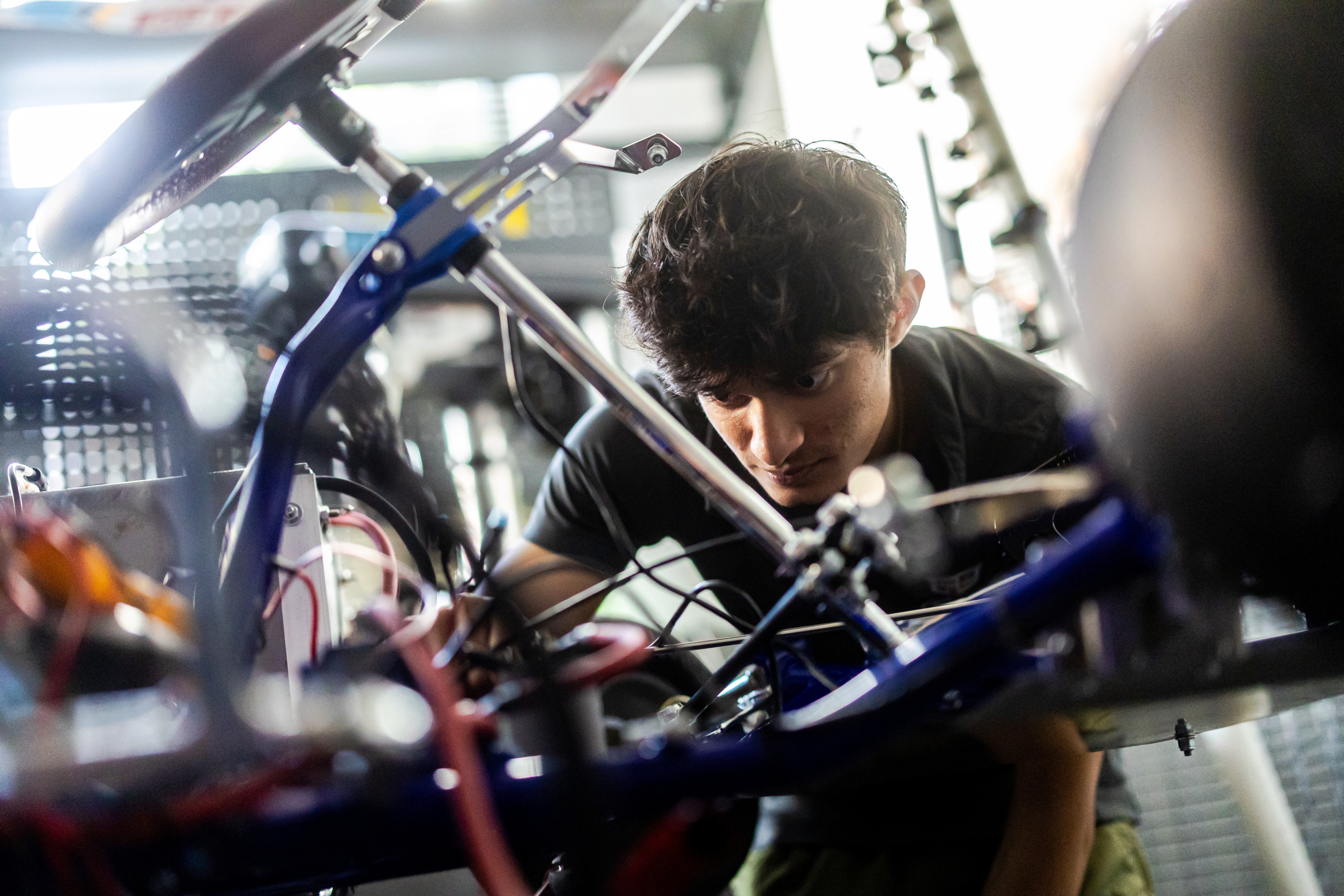
Inside the Loyola Vehicle Lab at the Doyle Center, several members of the Loyola EV Race Team huddled around an electric-powered go-kart. “If it beeps, it’s broken,” called out Kenan Chakich (BS ‘29), his eyes darting across a graphical display on a nearby computer monitor.
After months of work retrofitting the go-kart from a gas-powered model, the team was achingly close to completion. But there was just one wrinkle: the vehicle, outfitted with a 75-pound Lithium battery, an electric motor, and an Alltracks 48V 600 Amp controller, wasn’t powering on.
For the eight regularly participating members of the Loyola EV Race Team (also known as Loyola LIGHT), getting the circuitry working—and quickly—was extremely important. In just a few days, on Saturday, April 18, they were scheduled to represent Loyola University Chicago in its first appearance at the evGrand Prix at Purdue University, a racing event that began in 2010 with a $6 million grant from the Department of Energy. Drawing competitors from college teams across the region, it has blossomed into what event organizers have called the “Greatest Spectacle in College Racing.”
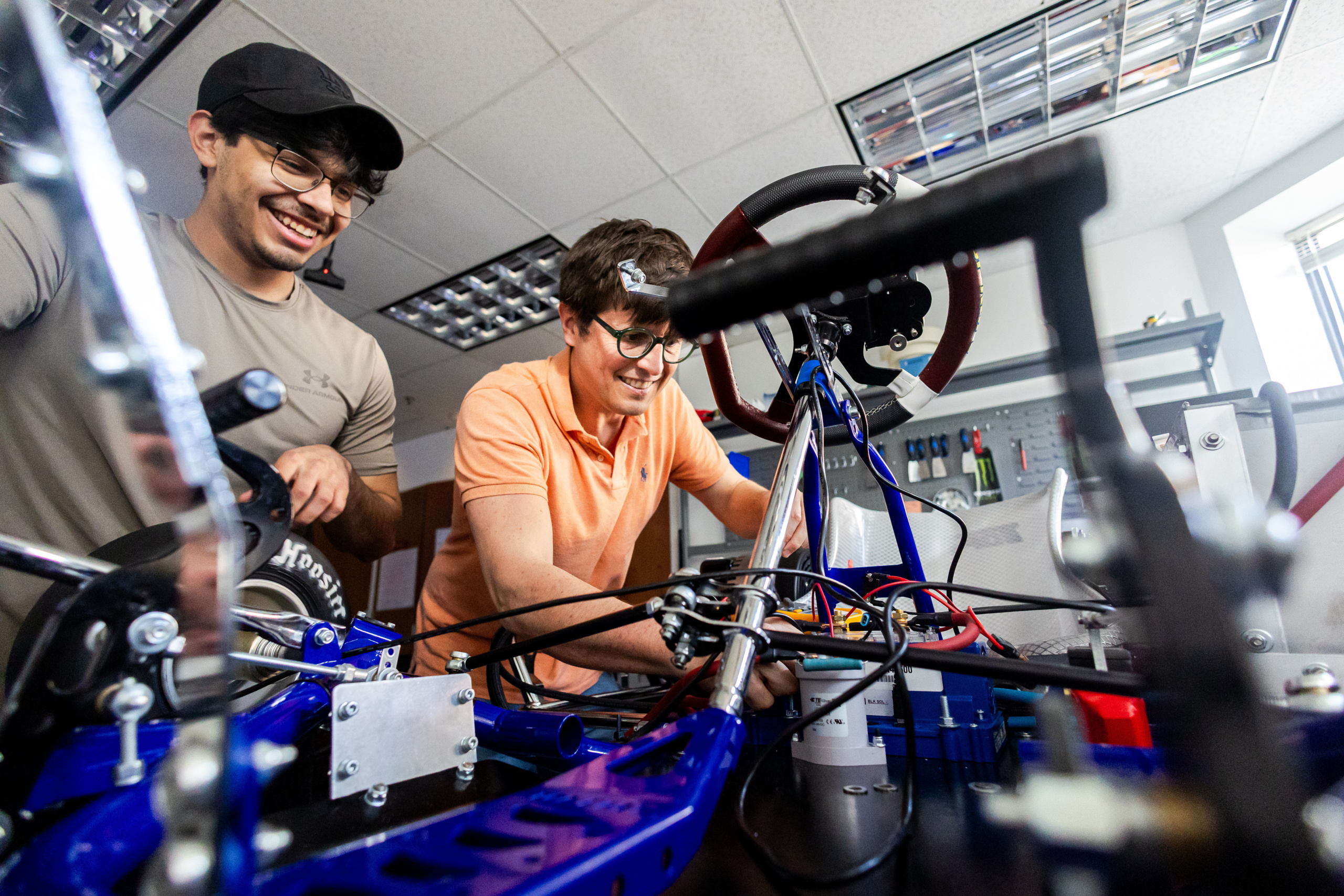
After some troubleshooting, the team solved the problem: a faulty ground connection on the motor controller. By repairing the controller’s internal circuit board, they were able to get electricity flowing from the battery to the controller and ignition switch. Just after dusk, the team rolled the car outside and took turns in the driver’s seat, testing the car’s acceleration and handling around Lake Shore Campus.
“This year, I think the goal is just to get the Loyola name out there,” said Carlos Alcala (BS ’27), the team’s captain. “To get a group, get [our car] out there, and be able to do more projects in the future.”
The relentless drive to succeed
Alcala plans to graduate in just three years. Among other achievements, the ambitious computer science major has served as an instructor and iOS developer for the nonprofit Everyone Can Code Chicago and spent a summer as a software engineering intern at Google’s headquarters in Mountain View, California, where his lunches often arrived by drone. Alcala was also a part of Northwestern University’s solar-powered vehicle team, NUSolar, which prompted his desire to start a similar vehicle design team at Loyola.
After winning the support of Neil Klingensmith, an assistant professor of Computer Science and one of the team’s two faculty advisors, Alcala began knocking on doors to rally support for the EV project and raise funds to build the roughly $12,000 vehicle. He reached out to Home Depot, Clark-Devon Hardware, Hoosier Racing Tire, PTC, and the lithium battery manufacturer LiTime, who agreed to pitch in funding or in-kind donations.
“Carlos is just dogged,” Klingensmith said. “If he wants to do something, he will find a way to get it done.”
Other team members have been just as stubborn in their desire to see the project succeed. Jayson Shah (BBA ’27), a sophomore finance and information systems major at the Quinlan School of Business, first learned of the Loyola EV Race Team through a friend. He began coming to twice-weekly evening meetings and was soon enlisted as the team’s driver. While his skill set falls outside of electrical engineering, he has found other ways to contribute to the team.
At his home in Gurnee, Illinois, Shah runs a full-service automotive business called JJ Cars. Launched in August, 2024 and reaching a growing client base, the business buys and retools stock cars to sell, rent, and race in local competitions. The EV competition has taken Shah’s skills a step further. To accommodate an electric motor, the EV Race Team modified the drive train of a chassis designed for a gas-powered engine. In the assembly process, Shah also learned how to mount and install a lithium battery, configure the vehicle’s wiring and motor controller, and test the electrical components to ensure unbroken power flow across the system.
“You put everything together like Lego,” Shah said. “You have a diagram of where things go, and we followed that.”
Paving the way for a driverless future
For the Loyola EV Race Team, the race did not go as planned; a missing sprocket guard, jarred loose from the go-kart during the team’s trip to West Lafayette, Indiana, prevented the team from competing.
But Klingensmith, a self-described “start-up guy,” views the project as a success, both for its educational value and potential to draw student interest in the Loyola Vehicle Lab. The team’s involvement in the competition, he says, could set the stage for future project competitions and help propel autonomous vehicle research already underway.
“One of the things that our department really emphasizes is that when you graduate with a computer science degree, you will have practical training. But a lot of those practical experiences are hard to come by. Some of our students will do an internship or they’ll do some research, and they get a benefit from that. But I think having experience working on a physical product, like a car [or a go-kart], is so much more valuable,” he said.
Co-led by Klingensmith, Professor Konstantin Laufer, and George Thiruvathukal, chair of the Department of Computer Science, the Vehicle Lab is a small but well-appointed room furnished with computers, workbenches, a drill press, and hand tools hung on pegboards. It formed in 2022 as a hub for autonomous vehicle research after a Jacob Veselsky (BS’ 21, MS’ 23), then a master’s student, and faculty co-authors Klingensmith and Thiruvathukal presented an eye-opening paper at the 2022 2nd Workshop on Data-Driven and Intelligent Cyber-Physical Systems for Smart Cities Workshop (DI-CPS).
The preliminary study showed compelling evidence of a new way for autonomous vehicles to communicate with one another by exchanging GPS and visual data across digitally linked sensors. By syncing data from multiple vehicles, Klingensmith told me, the experiment’s sensor fusion model demonstrated how autonomous vehicles can work together to detect and respond to potential hazards, such pedestrians, cyclists, and wildlife. In essence, the networked computer vision systems pool data to create extra sets of “eyes” on the road.
“[Many of] our communication systems are highly interconnected, but our cars are islands,” Klingensmith said. “They have super sophisticated sensors, but almost no information outside their line of ‘sight’ … we would be much safer by building these linked systems onto them.”
The future Klingensmith describes may not be so far away, especially as autonomous vehicles become more prevalent. Waymo now operates fully driverless taxis in 11 U.S. cities, and is testing them in 20 other cities, including Chicago, where manually driven Jaguar I-PACE SUVs are mapping city streets and traffic patterns. Meanwhile, ridesharing platforms such as Uber and Lyft are steadily integrating AVs into their networks.
Even for Loyola students entering future racing competitions, the path forward may be driverless. “We’ve done some research projects in the lab related to autonomous vehicles, and so that is a direction that we kind of want to take this,” Klingensmith said. “That’s probably going to be the next step: to take the driver out of the driver’s seat and put a computer in there.”
For Alcala, who hopes to work in a cutting-edge research environment, that’s a thrilling possibility. “Google is constantly working on technologies that don’t exist yet, right? So that’s what I want to do. Instead of managing databases at a big company, I want to be able to work on a team that’s moving forward as much as possible—always creating something new.”