


Chicago is the world’s most climate-resilient city. Loyola helped it get there
October 5, 2026
Share



Chicago topped the list of the world’s most climate-resilient cities, as evaluated by AlphaGeo, a Singapore-based company that ranked 72 of the world’s largest cities based on their exposure to climate risks and ability to reduce adverse impacts from extreme weather events.
“The good news is they call us out and highlight what we have here in Chicago, which is plentiful, clean water and relatively good air quality,” says Aaron Durnbaugh, director of sustainability at Loyola University Chicago. “Although we’re seeing more extreme weather in Chicago, it’s not what folks deal with on the coasts with hurricanes and typhoons or in heavily wooded landscapes prone to wildfires.”
Durnbaugh, a former deputy commissioner in the City of Chicago’s Department of the Environment and one of the chief architects of its pioneering 2008 Climate Action Plan, says Chicago’s privileged geographical location only tells part of the story. The city’s decades-long focus on climate adaptation planning has paid off in infrastructure upgrades, power grid diversification, and emergency response systems that have helped Chicago brace itself for the hostile effects of shifting climate patterns.
Two measures, in particular, stand out.
One of the things you see with these roadmaps is the real rubber hits the road, in terms of implementation. And that's what gets me excited about Loyola. We're walking the walk, we're achieving our targets, and the city is too.
— Gilbert Michaud, assistant professor of environmental policy in the School of Environmental Sustainability
Following a heat wave in 1995 that led to the deaths of more than 700 Chicagoans, many of them older adults and people of color, the city invested in new cooling centers, launched wellness checks for at-risk residents, and fortified its power grid to prevent the kind of rolling brownouts that left tens of thousands of residents without power and air conditioning for days during the heat wave.
The city also bolstered its stormwater management infrastructure, widening piping conduits in its combined sewer system, leveraging plant-based infrastructure to absorb rainwater, and partnering with the Metropolitan Water Reclamation District of Greater Chicago to advance the development of the Deep Tunnel, a 110-mile-long infrastructure system begun in the 1970s and still underway that conveys water to reservoirs and treatment plants through massive underground tunnels.
“We’ve done a lot of things here in our region to improve our infrastructure, including our social infrastructure,” Durnbaugh said. “We’ve created cooling centers. We’ve created social service and public health programs that make sure that people are safe. At the same time, we’ve invested a lot in the hardening of our grid, so that electricity is available even under the most extreme or peak conditions.”
The long road to building a climate-resilient campus
If the recognition comes as welcome news for the city, it is also an auspicious sign for Loyola, whose climate adaptation vision is guided by the Office of Sustainability and the School of Environmental Sustainability and closely aligned with Loyola’s Jesuit mission and commitment to integral ecology.
Under the leadership of Durnbaugh and others, Loyola’s 2015-2025 Climate Action Plan, A Just Future, positioned it to become the first university in the Chicago area to achieve carbon neutrality for its primary energy use. The University’s progress toward net-zero emissions has fulfilled several recent milestones, including a commitment to 100 percent renewable electricity; $150 million invested in high-performing buildings and the long-term Campus Plan; the growth of SES; and the inclusion of sustainability in the University’s core undergraduate curriculum.
“Both the city and Loyola have recent climate action plans,” says Gilbert Michaud, an assistant professor of environmental policy in the School of Environmental Sustainability. “What I really appreciate is that we’re actually taking tangible steps to achieve them. One of the things you see with these roadmaps is the real rubber hits the road, in terms of implementation. And that’s what gets me excited about Loyola. We’re walking the walk, we’re achieving our targets, and the city is too.”
Durnbaugh cites several efforts that have helped Loyola draw national attention for its climate resiliency efforts—and they go well beyond decarbonization. In the 1990s, when erosion threatened the stability of high-rises south of campus, Loyola built a sea wall along Lake Michigan to fortify the shoreline near Santa Clara Hall, and raised several building foundations to prevent groundwater infiltration.
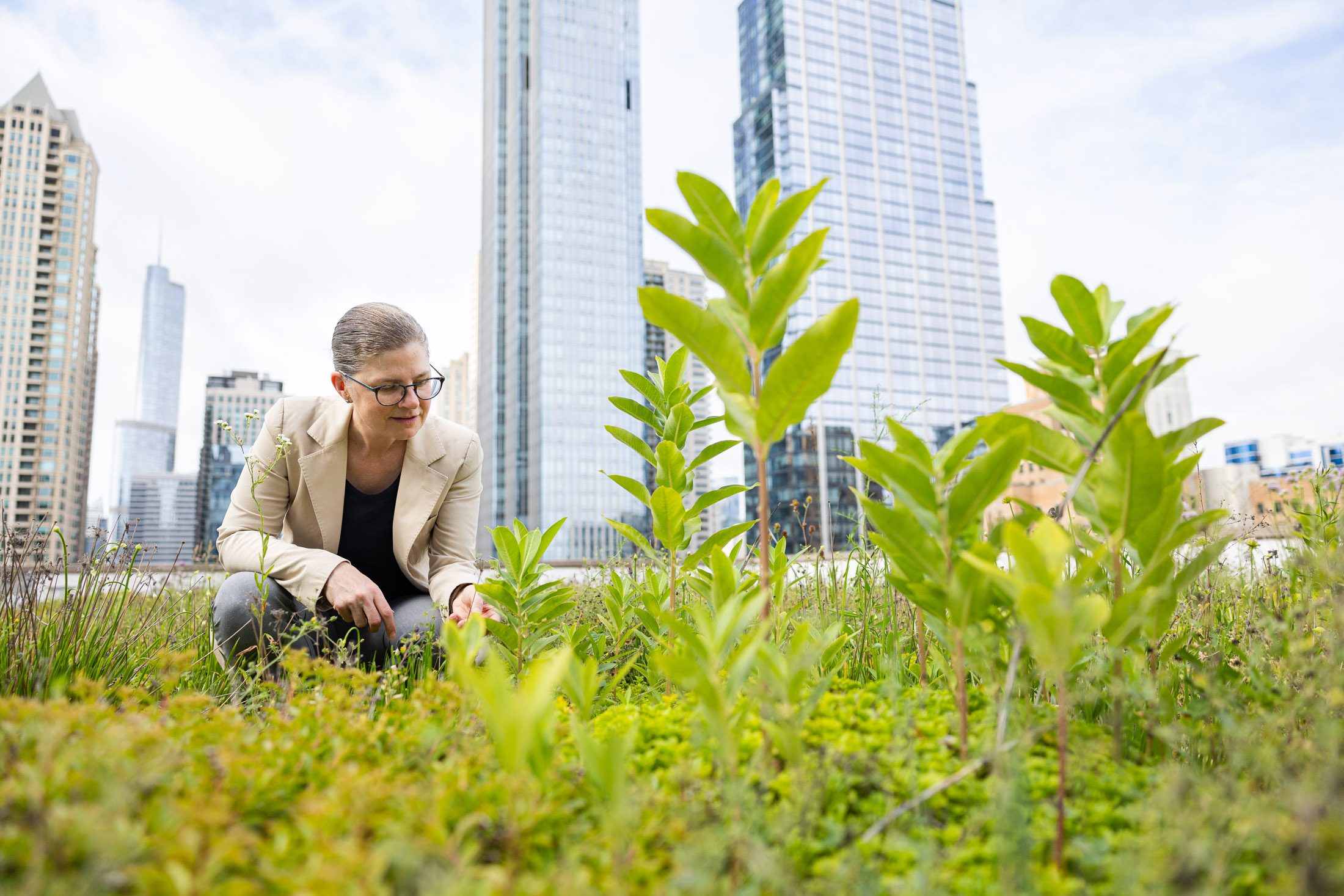
More recently, Loyola expanded a chiller plant to keep buildings cool in the face of warming temperatures, created text-based emergency alert systems, and implemented an extensive stormwater management system that includes 17 green roofs spanning more than 55,000 square feet, along with rain gardens, semi-permeable walkways, and underground stormwater infiltration vaults. The system diverts an estimated 19 million gallons of water from city sewers annually—enough to connect Chicago to Houston with one-gallon water jugs.
“Our stormwater system is not just taking pressure off of someone down the sewershed from us,” Durnbaugh said. “But also because we’re next to Lake Michigan, we can direct that water where, historically, it used to go, which is back out to Lake Michigan.”
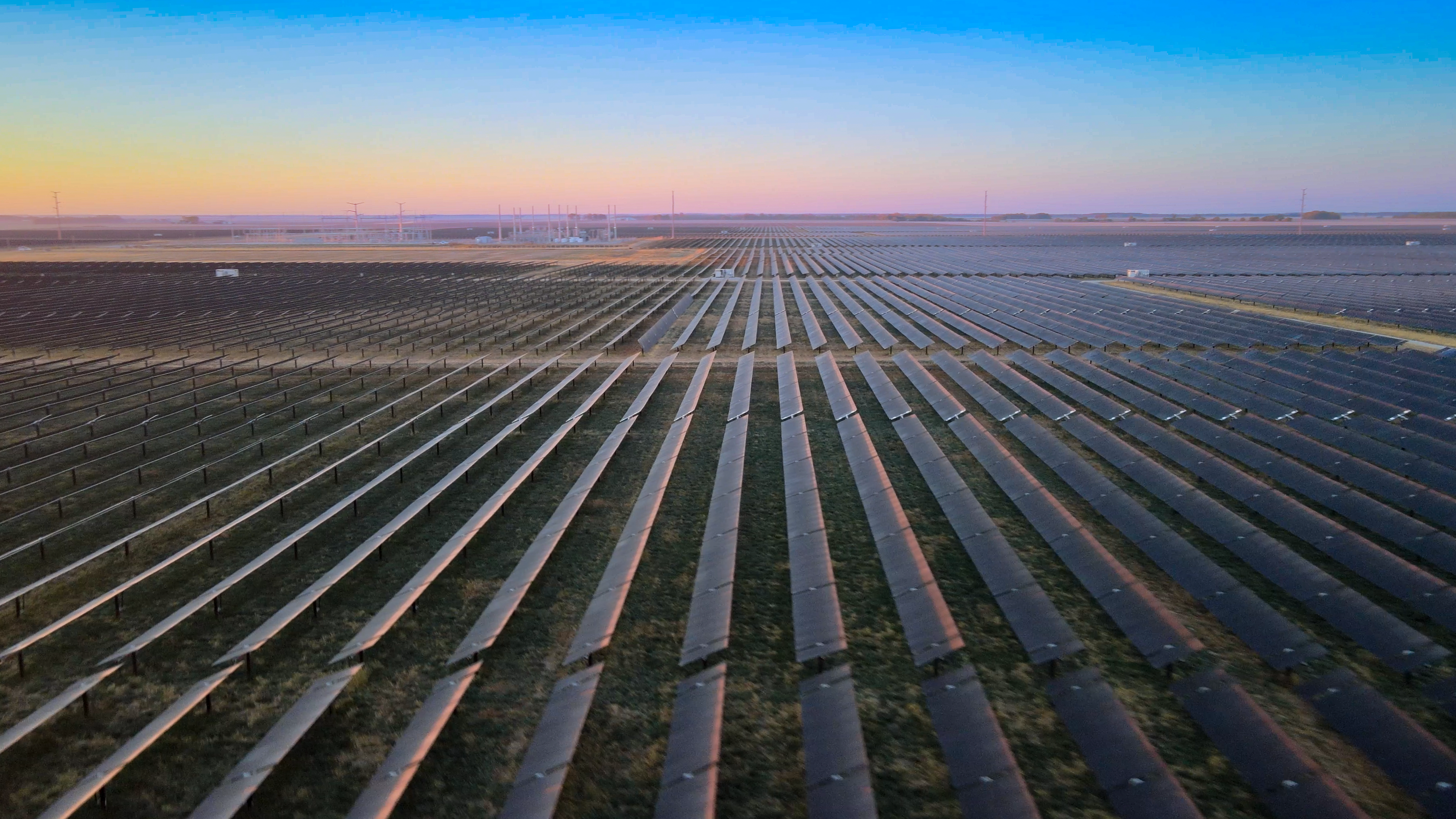
Perhaps the biggest recent energy transition the University has undergone is a 12-year power purchase agreement with Constellation that began on January 1, 2025. Through the fixed-position contract, Loyola has agreed to buy an estimated 81,660 megawatt hours of electricity annually from the Double Black Diamond solar farm, the largest utility-scale solar project east of the Mississippi River.
The solar energy agreement, aligned with Illinois’ target for zero emissions by 2050 under the Climate and Equitable Jobs Act, helps Loyola bring more clean, renewable energy onto the PJM regional transmission grid that feeds into ComEd’s local distribution network. Since electricity pricing fluctuates with demand, on hot summer days and cold winter days when electricity is in heavy use, Loyola can earn money back.
“We’re signing a contract to lock in the purchase of renewable energy at a fixed rate,” Michaud said. “Not only is it good from a climate and renewable energy standpoint, but it’s also a hedge against future fuel price increases.”
These efforts, along with students’ active role in biodiesel production, waste diversion, and urban agriculture programs, helped Loyola earn the Platinum rating—the highest possible—from the Association for the Advancement of Sustainability in Higher Education (AASHE) in their Sustainability Tracking, Assessment & Rating System (STARS). Loyola is the first institution in the Midwest to achieve the Platinum designation and joins only 10 other U.S.-based and seven international institutions in receiving the distinction.
Soon, Michaud says, that number could grow as other universities look to pioneering schools like Loyola as models.
“You have other colleges and campuses that are sort of looking at what we’re doing and having conversations with their faculty and staff, and maybe up to the president and board of trustees. Like, should we be doing this too? Should we also invest in solar? Should we also invest in high-performing buildings?”
Growing risks
Durnbaugh and Michaud are, of course, not the only climate resiliency experts at Loyola who have had a hand in shaping Chicago’s climate adaptation strategy.
Karen Weigert, the director of the Baumhart Center for Social Enterprise and Responsibility at the Quinlan School of Business, was the City of Chicago’s first chief sustainability officer, a position created under former mayor Rahm Emanuel. During her tenure, she led the development of the Sustainable Chicago Action Agenda that laid out 24 goals and more than 100 action items to help make the city more livable under changing climate conditions.
Though pleased by the city’s recent designation, she says there is plenty of work still to be done to prepare for growing climate hazards and extend resiliency efforts equitably across Chicago’s neighborhoods.
“Chicago and Loyola are very place-based, and so the success of where we are matters to both of these organizations and for everyone in them,” Weigert says. “We both are able to take a very long-term view and a very inclusive view about what it means to be stewards of this place for all of our people as we think about today and long into the future.”
While Chicago has taken significant strides forward to become more climate resilient, vast disparities exist among neighborhoods’ vulnerabilities, says Tania Schusler, an associate professor in the School of Environmental Sustainability. Older adults, young children, low-income individuals, those without access to housing and transportation, and those with existing health conditions tend to be the most severely affected.
She points to two findings in particular, one a study by the Center for Neighborhood Technology that found 87 percent of flood insurance claims between 2007 and 2016 occurred in communities of color, and the second, Chicago’s 2023 Cumulative Impact Assessment, which notes that “the areas of greatest concern for pollution burdens and vulnerability to its effects are located on the South and West Sides of the city” and “often bisected by major highways and have high concentrations of industry.”
“Chicago needs to continue to place social equity at the center of its climate action plans,” Schusler said.
Another concern, Durnbaugh says, is the effect of more frequent and severe rainfall. According to the Illinois Department of Natural Resources, annual total precipitation has increased by nearly 6 inches between 1895 and 2019, an approximately 15% increase. And a 2021 report of The Nature Conservancy found days with more than 2 inches of rainfall have increased 40% since the beginning of the 20th century.
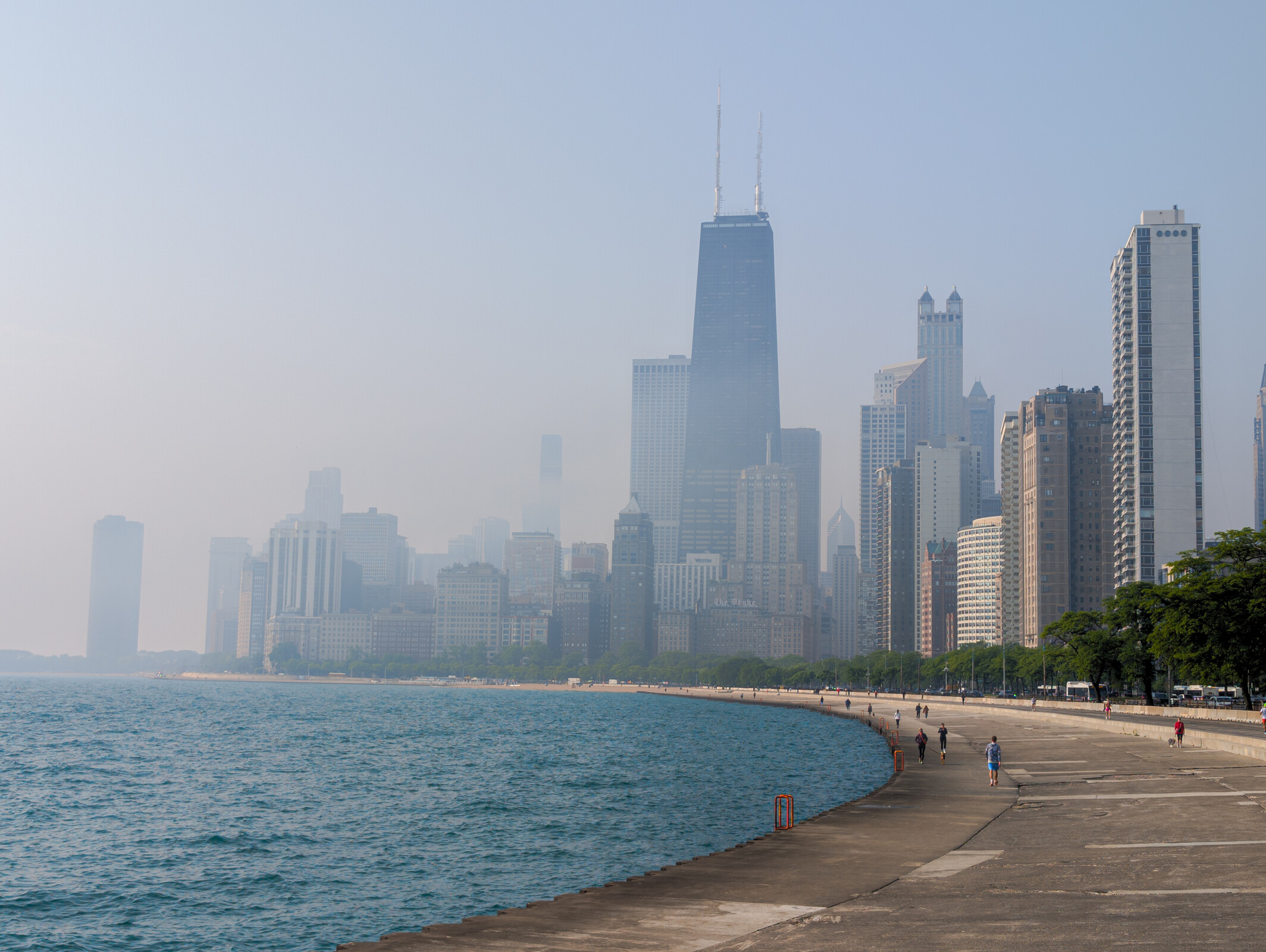
Climate change is also expected to bring a greater risk of exposure to hazardous air quality, a reality brought into stark relief this past July when smoke from Canadian wildfires enveloped Chicago and triggered Air Quality Alerts advising residents to stay indoors.
Ping Jing, a professor in the School of Environmental Sustainability, has studied the effect of wildfire smoke on ozone, pollution, and public health in Chicago’s communities. Her research has focused on two important air quality hazards that she says warrant close attention in Chicago and on Loyola’s campuses in the years ahead: ozone, and fine particulate matter, also known as PM 2.5, which has increased in Chicago significantly in recent years and can collect in lungs and be dangerous for people with asthma and other medical conditions.
While ozone in the stratosphere protects people from UV light, it is a strong oxidant that can cause irritation, tissue damage, and lung cancer. In a recent study, Jing and her co-authors found that wildfire smoke can increase ozone by as much as 6 parts per billion, nearly 10% of the U.S. 8-hour standard, with the most severe effects near major roadways and neighborhoods historically overburdened by pollution.
“The chemicals brought by the smoke react with local emissions to cause ozone to form,” she said. “Where do we see these local emissions? I-55, I-90, I-94. Along the major roadways. So Chicago no longer is in an ozone attainment area [it does not meet Clean Air Act standards], according to the U.S. EPA. Basically, Chicago’s ozone is coming back.”
Amplifying external impact
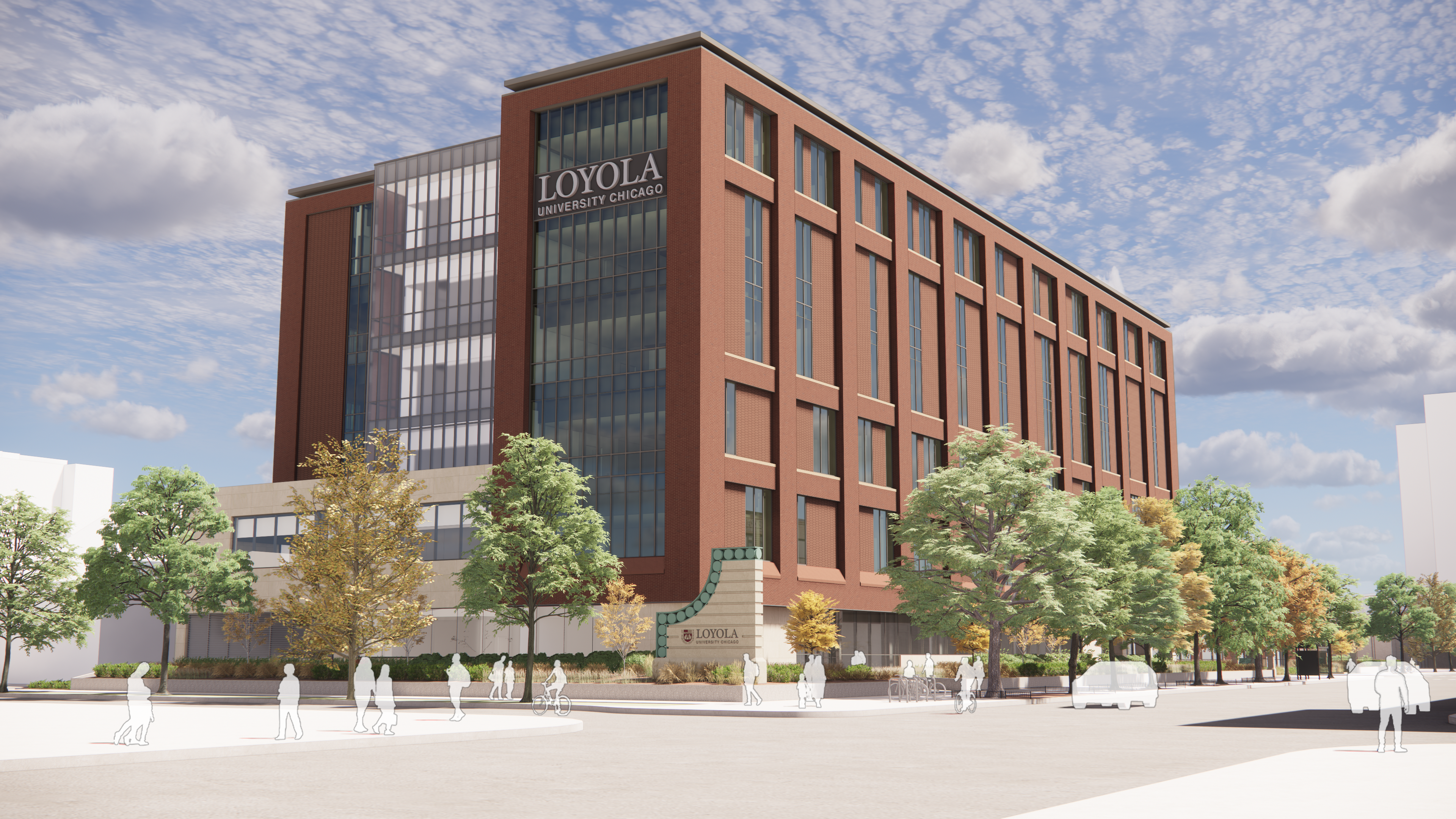
One visible expression of how Loyola is preparing for such rising climate threats can be found in a seven-story nursing and sciences education facility now under construction on the Lake Shore Campus and on track for LEED Gold Certification. The 195,000-square-foot facility, known as 1144 West Loyola, will bring together programs from the Marcella Niehoff School of Nursing and the College of Arts and Sciences in an energy efficient, high-performing building that will use an estimated 46 percent less energy than a typical, comparably sized lab building.
Design plans include a Konvekta Advanced Energy Recovery System that will provide 80 percent of the building’s heating and cooling demands without using fossil fuels. In addition, the building will feature onsite stormwater detention, an extensive modular tray green roof system, bird-safe glass, and a dark-sky compliant exterior lighting system designed to protect birds during migration season.
Loyola’s efforts to adapt to climate change extend beyond future-ready facilities. Loyola hosts an annual Climate Change Conference, and several current research partnerships are aimed at proactively responding to climate change, including work with the North Shore Mosquito Abatement District to reduce mosquito spread, a project funded by a $2.5 million grant from U.S. Department of Energy’s Solar Energy Technologies Office to study factors that influence community acceptance of large-scale solar projects, a research initiative with the Fe y Alegría rural school network to address water insecurity in Piura, Peru, and a National Science Foundation-funded effort in partnership with American University to measure the effectiveness of climate policies in more than 80 different countries.
Another institutional priority—and part of what attracted Michaud to Loyola—is the commitment to educate future leaders and practitioners who can help shape just, environmentally conscious programs and policies. With access to the Searle Biodiesel Lab, a greenhouse, onsite geothermal systems, high-tech research labs, and the 98-acre Loyola University Retreat and Ecology Campus in Woodstock, Illinois, students in the School of Environmental Sustainability engage directly with working models of climate resiliency—giving them exposure to natural systems and technologies at the vanguard of climate adaptation.
Michaud, who has written or co-authored roughly 90 technical reports and commentary pieces, says many graduate students in his Energy Law & Policy classes work, concurrently, in roles at local environmental advocacy organizations and government agencies, where assignments in his class spill over into real-world energy policies and programs.
“They’re coming up with tangible policy solutions and fundable ideas, and then often, due to the nature of their roles, they bring these projects they’re tackling into their professional lives, and actually, push for them or try to implement them,” Michaud says.
The Baumhart Scholars MBA program, a master’s program in the Quinlan School of Business focused on social and environmental impact, has a similarly viral effect, Weigert says, with “folks already working full time in sustainability, in climate adding an MBA skill set and network on top of that” to amplify their professional impact.
“We also have undergrads at the very beginnings of their careers working on these topics in summer internships and tying those experiences together with their classes, so that they can really launch their careers in this space. So we see that at multiple levels in the university,” Weigert says.
To carry forward its climate adaptation efforts, Loyola is currently developing its next-generation climate action plan, Climate Action Plan 2.0, as a component of its strategic plan, For the Greater Good. The plan is built around a continued commitment to transition to clean energy through decarbonization and sets forth a bold agenda to amplify Loyola’s impact in the region and globally.
“We know sustainability is an enduring value, but so is our Jesuit tradition. So is our commitment to inclusive excellence. So is our international and global awareness,” Durnbaugh says. “Moving forward, a key question surrounding our climate initiatives will be, ‘How do we make sure they’re having a multi-value impact?’”


