


Share



Storytelling on Loyola Today took our readers from the backstage of an alumni-owned music venue to the faith spaces that cultivate community on campus. Professors shared their expertise on emerging topics like artificial intelligence, providing a deeper look at new technology through a Jesuit lens. Loyola magazine put a spotlight on the members of Loyola’s alumni community who are creating touch-sensitive artificial limbs and breaking the NBA’s biggest news.
As the year draws to a close, catch up on the most-read stories from Loyola magazine and Loyola Today.

1. How ESPN’s Shams Charania (BA ’17) became the NBA’s scoop king
Shams Charania (BA ’17), the sports journalist who broke the massive trade between the Dallas Mavericks and Los Angeles Lakers earlier this year that included stars Luka Dončić and Anthony Davis, has become the premier NBA breaking news source. Charania worked relentlessly through his early career, balancing breaking stories with his classwork at Loyola, where he studied at the School of Communication.
“Anytime you’re young and trying to pursue something, there’s no template,” Charania says.

2. Honoring an icon
When Sister Jean Dolores Schmidt, BVM, died in October at the age of 106, the Loyola community gathered in a week of remembrance that culminated in a well-attended wake and funeral mass at Madonna della Strada Chapel. Rev. Michael J. Garanzini, S.J., president emeritus of Loyola, offered a homily celebrating the “small acts of kindness that endeared [Sister Jean] to thousands.”
“No one better exemplified a Christian Ignatian educator,” he said, calling her an “ever-present surrogate grandmother to countless students.”
3. Rooted in Jesuit tradition, Loyola builds community among faiths
From its 1870 founding as St. Ignatius College in Chicago’s Near North Side neighborhood, Loyola has made Jesuit, Catholic principles the bedrock of its mission and ethos. An 1870–1871 school catalog notes that Catholic students were “frequently and carefully instructed in their holy religion,” with “the most solicitous attention paid to the morals of all.”
“We take our religion so seriously, but because we do, we educate all and meet people where they are. We propose, we discuss, but we don’t insist,” says Michael Murphy, the director of Loyola’s Hank Center for the Catholic Intellectual Heritage. “We ask, ‘What is God doing over there? Where might we need to meet with our imagination to cultivate faith, reason, and a more humane and just society?’”
4. With head, heart, and guts, Allison Guth is coaching the Ramblers to success
Ramblers women’s basketball Head Coach Allison Guth shares her inspiring philosophy on resilience, failure, and teamwork that provides the foundation for her coaching leadership.
“The ability to push yourself to the limit, to see the world outside of yourself, and to serve, that’s what the game of basketball is. It’s about celebrating the stat that doesn’t show up. It’s the charge take, the gut play. It’s our entire culture at Loyola,” Guth says.
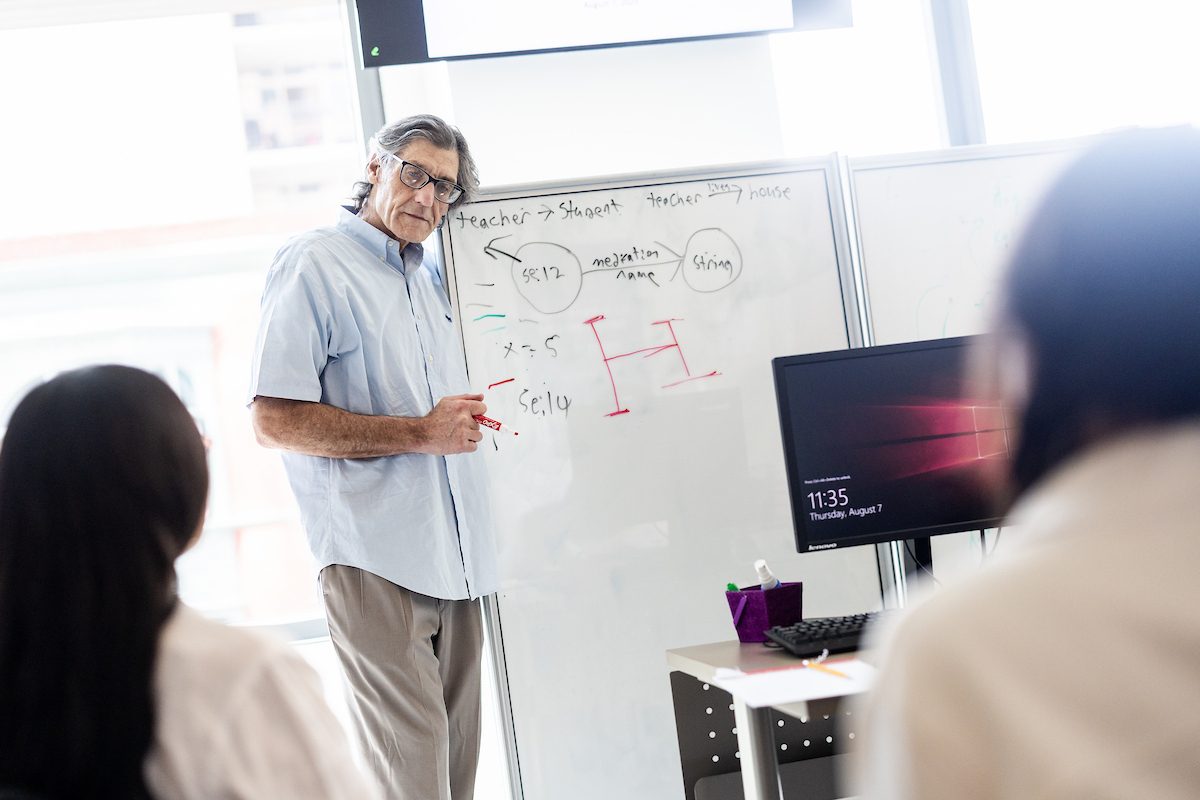
5. How Loyola is bringing artificial intelligence and ethics into the classroom
As they integrate AI in their classrooms, many professors at Loyola are attempting to strike a delicate balance: embracing the technology for education and research aimed at benefiting the common good, while taking steps to heed the warnings of Pope Leo XIV, who, in his inaugural address to the College of Cardinals, noted the risks artificial intelligence—if not properly addressed—poses to “human dignity, justice and labor.”
Using artificial intelligence ethically and responsibly—to support and augment critical thinking, rather than to stand in for it—will “make a big, big difference in our students’ abilities to get jobs,” said Executive Lecturer Steven Keith Platt, who directs the AI Business Consortium and the Lab for Applied AI in the Quinlan School of Business.

6. A spotlight on the Class of ’25: Ramblers reflect and prepare for new horizons
Grads from the Class of 2025 shared their favorite Loyola memories, from Friday nights in a soup kitchen to study abroad experiences. A few faculty members also provided life advice for graduates as they embark on their careers.
7. How a Loyola alum built the world’s first touch-sensing bionic hand
Aadeel Akhtar (BS ’07, MS ’08) has made it possible for amputees to simulate feeling with the Ability Hand, a bionic prosthetic hand that allows its user to more easily perform two handed functions. Inspired by a trip to Ecuador, Akhtar created a top-tier, easy-to-use device that was also economically accessible.
“For us, at PSYONIC, yes, we are pushing to make the most advanced technologically possible bionic limbs, but we also have to make them accessible because if they’re not accessible, then it defeats the entire purpose of everything that we’re trying to do,” Akhtar says.

8. At the U.S.-Mexico border, Loyola law students learn to be people for others
Loyola law students joined six faculty members on a weeklong immersion trip to southern Arizona for a course called Immigration Practicum: Advancing International Human Rights Protections.
The Loyola School of Law’s Center for the Human Rights of Children, an interdisciplinary academic center with a mission to advance and protect the rights of young people, spearheaded the trip, which engaged students in critical questions surrounding asylum and human rights.
“Many, many components of the University have been focused on this one issue: How do we serve and accompany migrants?” Michèle Alexandre, the dean of the School of Law, said.

9. Meet the Loyola alum whose honey has Chicago foodies abuzz
Abdullah Motiwala (BS ’14) grew up hating honey. Once Motiwala tried the real stuff—raw, unfiltered, unpasteurized—he could immediately taste the difference. That taste of the good stuff formed the foundation for what would become Heaven’s Honey, the Elmhurst-based honey business that Motiwala founded in 2015.
“There was this gap between the chefs who wanted the product, and the supplier who couldn’t meet demands,” Motiwala told Loyola Today. “There had to be somebody who was in the middle as a beekeeper, as someone who cares deeply about the bees and understands the culinary world, to say, ‘OK chef, we’ll work with you.’”

10. Alum’s business Bookclub brings underground music to the masses
2025 saw the opening of Bookclub, a speakeasy-esque music venue founded and co-owned by Cam Stacey (BBA ’18). With a top-notch sound system, the venue serves as a space for local, underground bands and artists to play gigs and potentially reach larger audiences.
“Coming in here wanting a space to be run by artists who have other artists’ best interests at heart. I think that intention is what makes our remix of the Elbo Room something true to the original,” he says.
@loyolachicago Loyola alum Cam Stacey (BBA ’18) is amplifying Chicago’s underground music scene with @bookclubchi —a reimagined venue that’s all about community and creativity. @lucalumni #loyolachicago #bookclub #chicago #musicvenue ♬ Let Go NJ Edit VIP – h.o.l


