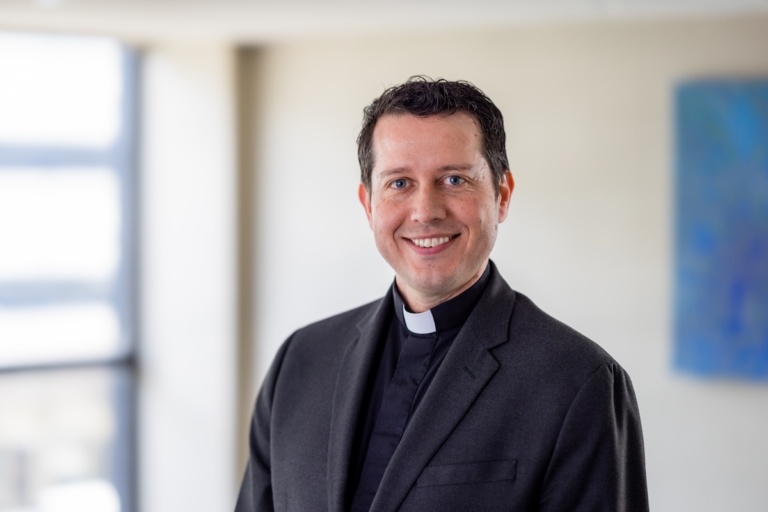
(Photo: Lukas Keapproth)
University Leadership

New book offers new vision for public health care

May 8, 2026

In his new book, Growing our Moral Imagination: Approaching Health Care with a New Faith-Based Vision (Hopkins Press, 2026), Associate Professor of Healthcare Administration and Vice Provost of Strategic Initiatives Fr. Michael Rozier, S.J., examines the intersections of physical care and social policies to envision a more holistic, community-focused approach to health care. The new work challenges traditional mindsets around barriers in the health care system and demonstrates how religious insights can guide practitioners toward more respectful and compassionate patient care. 

What inspired you to write this book? 

As a Jesuit working in fields such as health policy, health management, and public health, I’m always searching for connections between my religious worldview and the health-related challenges we are trying to solve. Medicine and nursing have much clearer connections; they have more obvious narratives about the healing ministry of Jesus to draw upon. This book is an attempt to share some of the insights I’ve gained in how we might better connect religious wisdom with the big, health-related needs we all know we aren’t addressing very effectively.

What question or issue does your research seek to address?

The central question of the book is: What did Jesus teach us about the human person and human community that can help us reimagine the way we deliver health care in the US today? We have so many challenges where we aren’t really rising to the challenge – addictions, loneliness, social media, social safety nets, diminishment and death – and I think part of the problem is that, as professionals, we can find a technical solution. I think the more fundamental challenge, which has to be paired with the technical solution, is our vision for the world and how we live together. My hope is that this book invites us into those deeper conversations because I think it’s the only way we’ll make headway on these intractable challenges. 

How does your Jesuit formation and spirituality influence your public health research

This book is rooted in Ignatian imaginative prayer. Each chapter begins with an imaginative recounting of a familiar moment in the Gospels and then applies those insights to the public health or health care challenges of todayThat is basically what drew me into public health and what sustains me in this field. Much of my research can be technical and quantitative, but all the questions emerge from a prayerful imagination of what’s really going on in people’s lives and in the world around us. 

How did writing this book influence your teaching and leadership?  

Even though this book explores some of the innumerable challenges in health care today, writing this book has made me more hopeful. I look around at students and my colleagues in health systems and realize the solutions to our problems are just waiting to be shown, if we can just create the openings for them to do the good work that’s inside of them. 

What do you hope readers gain from reading this book? 

I hope readers believe that more is actually possible from our health care system. Far too often, those delivering care and those in need of care feel trapped by a system that isn’t working. It doesn’t have to be that way. And I believe change should be rooted in a vision that life is both sacred and social, which the Catholic moral tradition and Scripture can uniquely provide for us. 

What did you enjoy most about writing this book? 

I love working with college students, especially as they figure out how to use their gifts. As I was writing, I regularly found myself thinking of all the students I’ve taught over the years who will be part of transforming our health care system for the better. If this book can be a small assistance in them doing so, I’ll consider it a huge success. 

What surprised you most about writing this book?  

I was pleasantly surprised that a non-religious, academic press like Johns Hopkins Press would be interested in publishing the book. Everyone at the Press, particularly my editor, has been incredibly supportive of the project, and it has reinforced my instinct that people are more open to and curious about one another than what gets portrayed in our media. 

What’s next for your research?  

I’m working on a second book that is a more academic exploration of how to structure the health care system so that it embodies the values that we hold most dear. This first book is meant to be more aspirational and inspirational. The second book will be more technical. While different in style, they are both pointing in the same direction. 

Portrait of Michael Rozier, S.J.

Michael Rozier, S.J.

Associate Professor, Healthcare Administration
Vice Provost for Strategic Initiatives

Contact: mrozier@luc.edu

School: Parkinson School of Health Sciences and Public Health

Expertise: Health, Religion

Focus Areas:

See Profile
  • Nonprofit health care
  • Public health ethics
  • Catholic health systems
  • Health policy