


Share



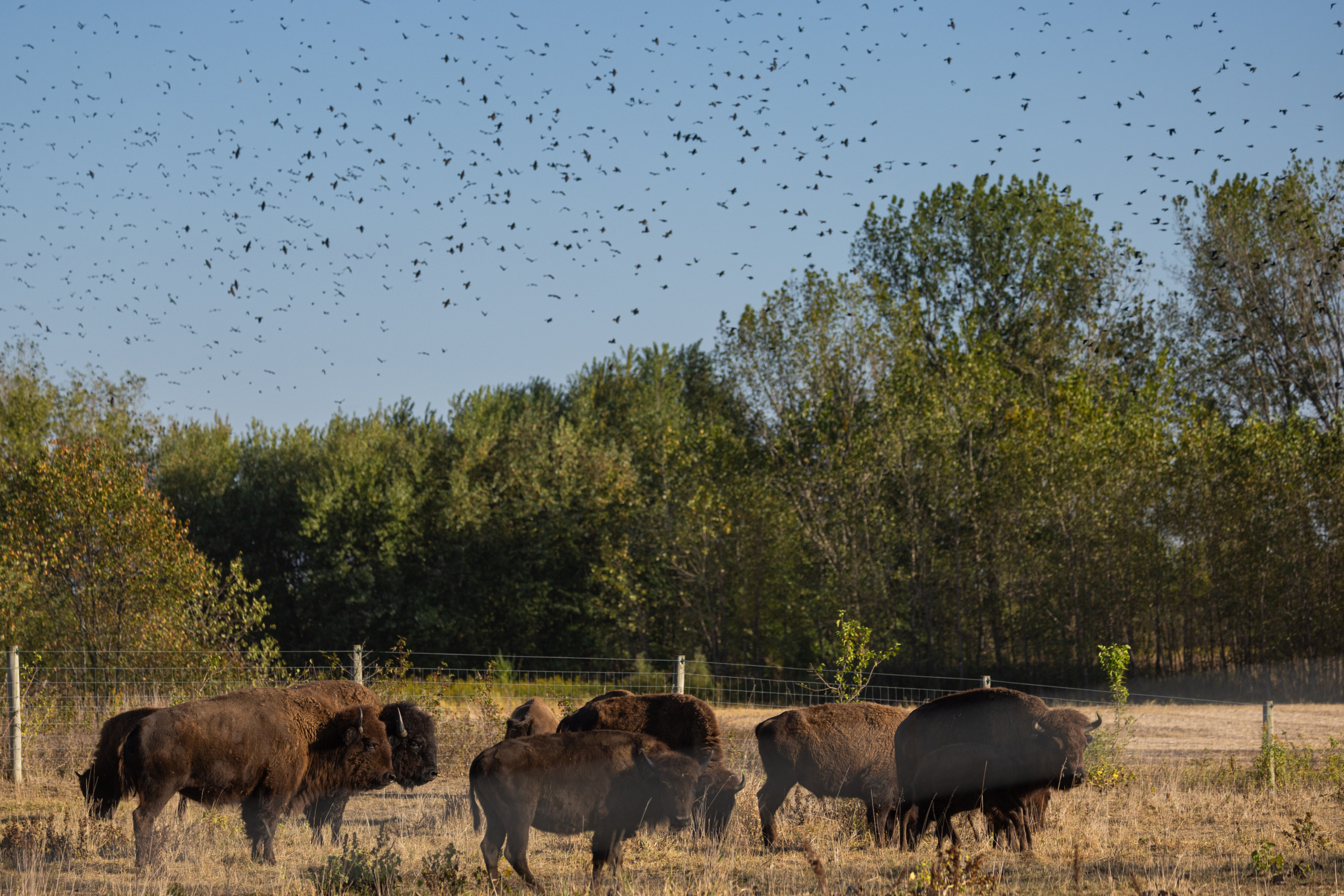
Phillip Rowell (BBA ’06, MJ ’15) steered a Kawasaki Mule utility vehicle to the edge of a fenced-in pasture at Ironhide Bison in Villa Grove, Illinois, and slowed to a stop. In the near distance, more than 30 bison thudded across the prairie, huffing and swinging their tails. Closest to the fence, the dominant bull, a massive animal with a woolly brown coat tossed his horns and made his presence known.
“So his name’s Ironhide, like the ranch,” Rowell said, stepping off the vehicle. He scooped a clump of nutritional Purina Cattle Cubes from a 50-pound bag and tossed them over the electric fence. “He likes to eat first.”
Feeding Ironhide and the rest of the herd the cattle cubes, along with hay and grain, has become a regular part of Phillip’s routine since fall 2024, when he and his wife, Jennifer Rowell (BBA ’09, MEd ’21) made a roughly half-million-dollar investment in the 70-acre bison ranch. The property, which opened to guests in September 2025, includes a two-bedroom Airbnb farmhouse, an outdoor seating area and fire pit, and a country store that offers frozen cuts of bison meat and Midwest food products, like honey, preserves, and apple butter.
“Will this be forever? Will I be a bison rancher for the next 50 years?” Phillip said. “Maybe. But right now, this is the perfect thing to do. It’s a renewed sense of purpose. I’ve got 35 animals that are depending on myself, Jen, and my family.”

Taking over a bison ranch might seem like a wild idea for a couple with demanding full-time jobs and three young children, but the venture is not as farfetched as it might seem. For starters, Jennifer’s family has a history of working with the iconic animal. Her grandfather, Warren Van Hook, who lived in Tippecanoe County in west-central Indiana, once had the largest managed herd east of the Mississippi. “I feel likeI understand how to be in spaces with bison and feed them and not be threatened,” Jennifer said. And while the Loyola University Chicago alums haven’t left behind their professional careers just yet, they are hoping the venture will yield a modest profit and give them a way to immerse themselves more deeply in nature and enjoy the purpose-driven satisfaction of stewarding the land and animals.
The bison’s self-sufficiency is another reason the Rowells feel confident about the venture. Females give birth without human assistance, and the reddish-brown calves can walk just minutes after birth. Managed bison herds require dietary supplements—grain, hay, and vitamin boosters—to fill their nutritional needs. They must be rotated through pastures and rounded up for slaughtering, but, for the most part, management is hands off. “This is a big part of the attraction for us,” Phillip says. “This is a very self-sufficient animal, and they’ve been living this way for tens of thousands of years.”
And the Rowells have something else going for them: a willing and experienced mentor in Kathleen Ruhter, who owned and operated the property with her late husband prior to entering into a deferred purchase agreement with the Rowells in 2024. The arrangement is mutually beneficial. For the Rowells, finding a property with the infrastructure already in place gave them the assurance they needed to move forward with their purchase plans. Ruhter, meanwhile, has moved her operations to a McHenry County Conservation District site, where she has more room to rear a larger herd of yearlings to finishing age.
“We were totally blessed to find the Rowells,” Ruhter said. “I don’t think it could be a better situation because, one, they’re wonderful people, but they also want to steward the land, maintain the animals, and keep the business side of it going.”
The property itself is a rare find. Situated on the minerally deficient soil of a former coal mine and unfit for crop farming, it has remained relatively affordable. Plus, Ruhter and her husband have already done much of the heavy lifting, building out fences and corrals and reseeding the land with prairie grass mixes to rejuvenate the soil and provide plant material for the bison to eat. Best of all, it’s close: At roughly 30 miles from their home in Champaign, Illinois, the Rowells can drive to the ranch several times each week to tend to the bison or bring their children along for weekend getaways, birthday parties, and campouts. “When we found this property, it ticked all of the boxes in terms of proximity to our home and the opportunity to engage and do business on the site,” Phillip said.
A bullish market
Perhaps the biggest reason the Rowells are diving into the bison business may be its untapped economic potential. Growing interest in agritourism and lifestyle travel popularized by shows as diverse as Taylor Sheridan’s Yellowstone and Anthony Bourdain: Parts Unknown, coupled with increasing demand for sustainably raised, protein-rich bison meat in the U.S. and abroad and the vast reach of online marketing, has many midcareer corporate professionals trading in their badges for boots and balers.
If it’s a risk, it’s a calculated one, says Chad Kremer, the bison herd manager at Custer State Park in the Black Hills of South Dakota, and the immediate past president of the National Bison Association. As the domesticated cattle inventory shrinks due to drought and rising operation costs, the price of beef has steadily ticked up, making bison a more attractive option for buyers. “We are picking up some consumers that are saying, ‘Well, if I’m going to pay $10 a pound for ground beef, I might as well pay $4 or $5 more and buy bison because it’s leaner and it’s healthier,’” Kremer said. Writer Karen Fischer notes in Offrange, 85,000 bison were processed for meat in the U.S. in 2023, compared to 36 million domesticated cattle, leaving a supply deficit that benefits bison ranchers. “We can’t keep up with the demand,” Ruhter said.
Margins are undeniably tight. Phillip says an 800-pound yearling might yield 400 pounds of saleable meat, which can net roughly $3,000 to $4,000. After accounting for insurance fees and the costs to rear a calf to two to three years old and process it at a slaughterhouse, the profit for a single bison is minimal. Kremer aims for a gross margin of at least $500 per head.
Most of the roughly 2,000 private U.S. ranches and farms raising bison are small operations with few employees and sufficient pasture acreage for healthy grazing. Ranchers who are successful, Kremer says, practice safe, low-stress handling operations (bison can weigh up to a ton and run at breathtaking speeds of up to 35 miles per hour) and rely on diverse income streams from tours, farmer’s markets, and onsite stores to supplement meat sales.
Direct-to-consumer sales are crucial. Most large grocery store chains don’t sell bison meat or shelve limited stocks, which means sellers need a strong marketing presence to reach their customers. Providing recipes and cooking instructions on meat products—bison cooks faster than beef and is best at an internal temperature of 165 degrees—and advertising the health benefits of the lean, slightly gamey meat, which is lower in saturated fat than beef and rich in nutrients like iron, zinc, B vitamins, is another way for sellers to gain a competitive edge.
“We don’t want to be the next ‘Beef. It’s what’s for dinner,’” Kremer said. “We want to remain a premium product and pull those consumers in that are looking for the health benefits.
Income diversification
The Rowells have adopted these approaches, in no small part due to their Loyola education. As an undergraduate economics student at the Quinlan School of Business and, later, a graduate student in the Master of Juris prudence in Health Law program at the School of Law, Phillip developed the skills to set up Ironhide Bison as an LLC, engage environmental and public health authorities, and identify the signs of unmet market needs with growth potential. “To me, it’s all consulting: talking with people, understanding their needs, and trying to fill the gaps between what people want and what’s currently available,” he said.
Phillip’s strategic instincts pair well with Jennifer’s more tactical approach to business administration, which traces a direct line to her undergraduate work at the Quinlan School of Business and her later graduate studies at Loyola’s School of Education.
“Jenny is definitely the more procedural mind in our relationship, which is great. I’ll say, ‘Hey, let’s do this thing,’ and she’ll say, ‘Here are the 10 steps and ways we can make this happen,’” Phillip said.
The Rowells do not expect to turn a profit in their first year, but they are playing the long game and building the business as they go. In addition to freeze-dried meat sales, Ironhide Bison offers tastings, prairie restoration talks, Hummer EV tours, and educational tours for school and community groups—each contributing a small amount to the balance sheet.
The Airbnb, which rents for $250 to $300 per night, is well-furnished with homespun, cottage-core touches like an antique milk pail to hold umbrellas, an Illinois-shaped cutting board, and a mahogany china cabinet decorated with glazed ceramics. Dave Walker, a mortgage broker from Chicago’s South Side, came for the first time in late August with his girlfriend and his son Giovanni, a first-year student at the nearby University of Illinois. They hiked, ate bison chili, and wandered a nearby cemetery before dropping off Giovanni and his belongings in his newly assigned dorm room.
“We loved it there,” Walker said. “The accommodations were amazing. Decorations were amazing. Everything was set up perfectly.”
More recently, the Rowells acquired a 20,000-square-foot warehouse directly across from the ranch, which will be transformed into an event center, a museum dedicated to the property’s former mine No. 5 owned by the Ziegler Coal Company, and an expanded storefront. Later this year, they plan to develop several trails named after Native American tribes that once resided on the land, including the Peoria, Potawatomi, and Chickasaw, and recognize the tribes’ historical presence with a land acknowledgment statement.
Further afield, Phillip, an experienced software architect who previously launched an autonomous concession stand called the Ion Grove Cafe at the University of Illinois Willard Airport, plans to streamline the ranch’s efficiency with an automated gating system, soil sensors, and drones that remotely monitor the herd. Citing CNN cofounder Ted Turner, the world’s largest private owner of bison, as an inspiration, Phillip says he is also exploring opportunities to grow the herd through partnerships with bison ranchers, land stewards, and investors.
“It’s hockey stick growth, right?” he said. “It’s volume; it’s scale. Ted Turner’s operations are the goal, where you have something like 50,000 bison.”
That might be wishful thinking, but even if it is, the Rowells see the ranch as much more than an investment opportunity. After spending seven years in Australia, where they lived in Brisbane and Canberra and relished their excursions to local beaches and botanic gardens, the Rowells became enamored with the natural world. When they returned to the U.S., they wanted to reclaim an element of that outdoor lifestyle, and the bison ranch was a way to do that, even if it felt somewhat outside their comfort zone.
“This is the culmination of learned experience and aspirations,” Phillip said. “There are so many things you can do with your life. Just going after it and trying something new, I think that’s the confidence our time at Loyola gave us: the ability to believe in ourselves and believe in the network of people that surround us.”
There are so many things you can do with your life. Just going after it and trying something new, I think that’s the confidence our time at Loyola gave us: the ability to believe in ourselves and believe in the network of people that surround us.
— Phillip Rowell, co-owner, Ironhide Ranch
Ecosystem engineers
The enduring mystique of bison in American culture and the widely documented ecological benefits of their reintroduction in wildlife conservation areas such as Yellowstone National Park and Nachusa Grasslands, are further reasons to believe the Rowells’ side hustle may evolve into something more than a soul-nourishing pastime.
Ecologists consider bison a keystone species of the North American grassland. When free to graze, they can have a regenerative impact on the entire ecosystem. Their urine and dung act as natural fertilizers, promoting carbon and nitrogen cycling. Their cloven hooves aerate the soil as they roam. Even the way they groom themselves—by rolling in the dirt, or wallowing—promotes ecosystem health by creating shallow depressions that collect rainwater and allow diverse plant communities to take root. These plants feed insects and amphibians that, in turn, attract birds, reptiles, and small mammals.
For thousands of years, Native American tribes followed the bison’s seasonal migration over the vast grasslands of the Great Plains, from the Canadian prairies to northern Mexico, and from the Rocky Mountains to the Appalachians. “Bison have always been a commodity, a friend, a relative, and a life source for us,” said Doug Crow Ghost, the administrator of the Standing Rock Sioux Tribe Department of Water Resources and a member of the Lakota Nation. “Long ago, buffalo was our Walmart.”
But, as Fischer observes, surging demand for bison hides, along with efforts to build intercontinental railroads and drive nomadic Native American tribes onto reservations, nearly led the animals to extinction. By the late 1800s, fewer than 500 of the estimated 30 million bison that roamed North America at the time of European settlement remained on the continent.
Their steady comeback at ranches, wildlife conservation areas, and even unlikely settings like the campus of FermiNational Accelerator Laboratory in Batavia, Illinois, is a narrative that holds broad cultural sway—and not just among foodies and conservationists. “It’s our American animal,” Ruhter said. “It’s something that developed here, it’s ours, and it’s such a huge part of the country.”
During her time as the ranch’s owner, Ruhter sought to recover a small vestige of the indigenous Illinois tallgrass prairie ecosystem—now representing less than one-hundredth of one percent of the state’s land—by restoring the centuries-old symbiotic relationship between bison and prairie plants.
Now the Rowells are picking up where she left off. By allowing the herd to graze freely across large swaths of the 70-acre property, they let the bison, so-called “ecosystem engineers,” do their regenerative work on the landscape. As the bison roam from pasture to pasture, they forage on prairie plants, like big bluestem and wood grass, that provide nourishment. In return, the bison’s grazing improves the soil and promotes ecological diversity.
“It’s absolutely going to bring back the birds and some of the other life that need those grassland areas,” said Sarah Livesay, the executive director of Grand Prairie Friends, a conservation land trust headquartered at Warbler Ridge Conservation Area in southeastern Illinois.
Environmental stewardship is important to the Rowells, as is the sense of purpose that comes with caring for the herd and living in step with nature. If the couple is betting big on bison, it’s a bet they’ve been preparing for most of their lives.“My thing is say yes—because why not?” Jennifer said. “Go forth and set the world on fire. I really took that to heart, and I think that Phil did, too.”


