

Share



They came with suitcases, vacuums, books, plants, boxes of clothing, ottomans, minifridges, and microwaves. They came from 48 states and 45 countries, from Puerto Rico, Guam, and Washington, D.C. They were chosen from among more than 40,000 applicants, with 92 percent having completed at least one AP course and 82 percent having completed at least one honors course. They were smart, diverse, and overwhelmingly hopeful.
Students enrolled in the Class of 2030—more than 3,250 in all—came, above all, with excitement for the new world awaiting them.
Mia Dominguez (BS ’30), a first-year biology major from Aurora, Illinois, stepped into the stonework-finished lobby of San Francisco Hall just after 9 a.m. on Tuesday morning. Her parents, Esmeralda and Leobardo Dominguez, had dropped her off at a brick-paved road near the building’s entrance, where a crew of resident assistants and student volunteers unloaded her belongings into wheeled carts to usher them to her third-floor room.
“My grandparents and my aunts and uncles—they helped me load the car yesterday, and it was just very overwhelming. But it was happy because everybody’s happy that I’m here,” Dominguez said.
“My choice for moving out here and coming to Loyola was the prestige education that I’ll be able to get,” she continued. “I’m a first-generation student, so I really admire the diversity that Loyola has.”
After scanning a QR code at the registration desk, Dominguez claimed her room key and boarded the elevator to head up to her new room. She was eager to unpack and get settled in with her roommate, Jordyn Houston (BS ‘30), a pre-med student from Oswego, Illinois.
The two were already well acquainted. They met in the spring on a student-run Instagram community page and attended Loyola Weekend together in March and First-Year Summer Orientation in June. Before the start of the semester, they went furniture shopping together in Naperville, carefully plotting the decor and color palette of their shared room: a lively mix of burgundy, green, cheetah print, and pink. They both had an eye for fashion, lived in nearby suburbs, and sought a rigorous education in the sciences.
“Jordyn’s studying neuroscience, so I knew that we’d have the same kind of rigorous class workload,” Dominguez said. “And then we’re both really into fashion and have the same vibe. So picking out a theme for our room was pretty easy.”
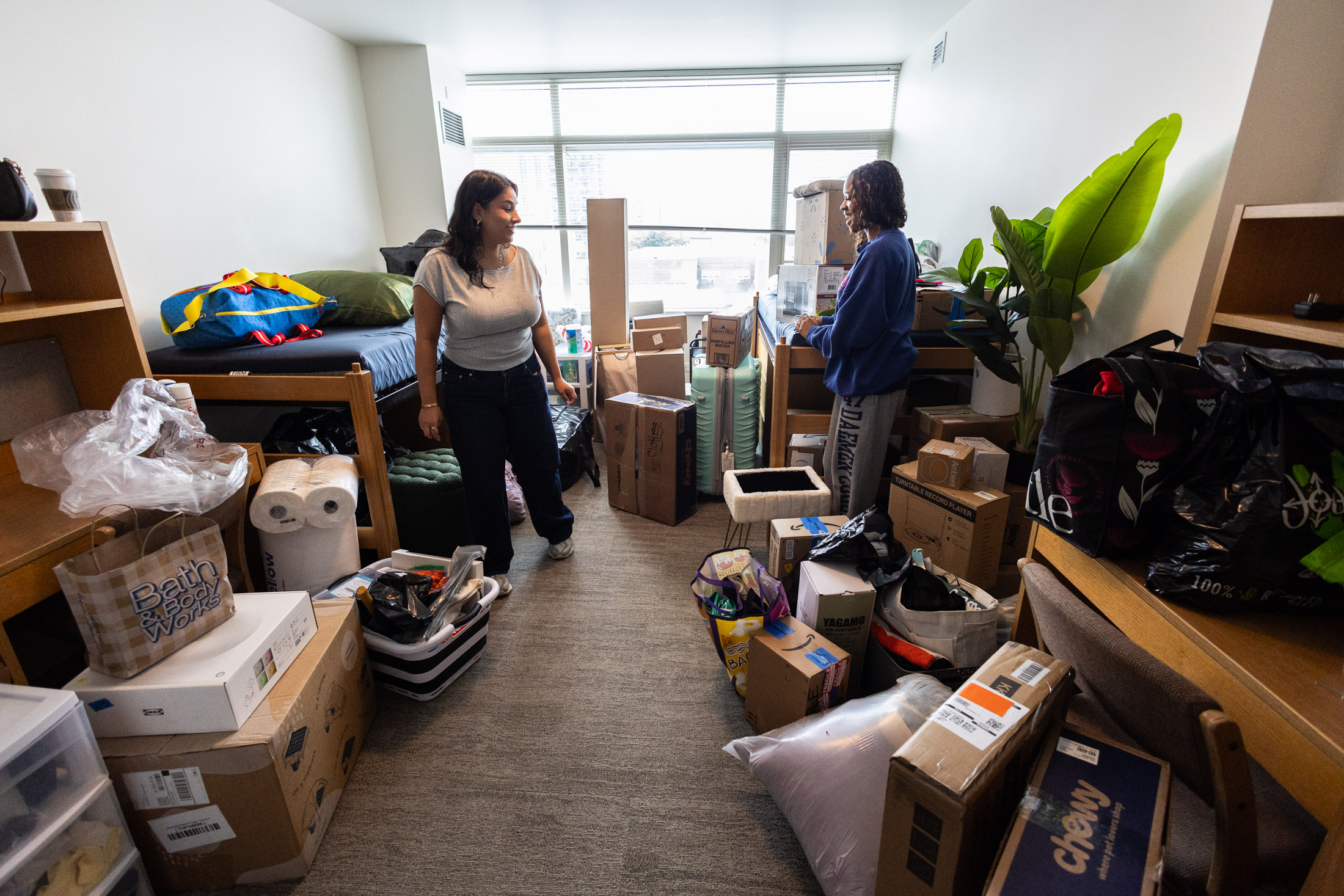
When Dominguez walked into the room, a double occupancy, 12- by 20-foot space with twin bunk beds, two desks, and two dressers, she shook her head in satisfaction. “It’s pretty good,” she said, heading toward a south-facing window looking onto a residential neighborhood in Rogers Park. “I was expecting something a little smaller. Actually, we have a pretty good view. I’ve got to check this out.”
My choice for moving out here and coming to Loyola was the prestige education that I'll be able to get. I'm a first-generation student, so I really admire the diversity that Loyola has.
— Mia Dominguez (BS '30), first-year biology major
An assist from family and friends
For the next half hour, student workers wheeled carts of her belongings into the room, as her parents, younger brother, Diego, and boyfriend, Daniel Herrera, helped her wipe down surfaces, unpack, and organize her room.
Among her possessions, Dominguez brought a mirror; a pegboard; a stuffed dinosaur; a bronze-framed folk painting called El Corazón Sagrado depicting an arresting arrangement of the moon, dice, a dove, and pink roses; and Chilean author Isabel Allende’s novel The House of the Spirits. She also brought several fan-leaved plants and succulents, fitting accents to room in a LEED-certified dorm adjoining the School of Environmental Sustainability.
Dominguez’s father, who maintains signal bridges for Union Pacific Railroad, was visibly flush with pride but unsure how to put into words a bittersweet tangle of emotions.
“It’s one of those moments where, yeah, we’re excited for her to start this, but she’s going to be away from home. Even though she is going to be just an hour and a half away, just not seeing her every day is going to be hard at the beginning,” he said.
“But I’m happy about it. It’s great. It will be even smoother when my son Diego does this,” he said, flashing a smile at his son.
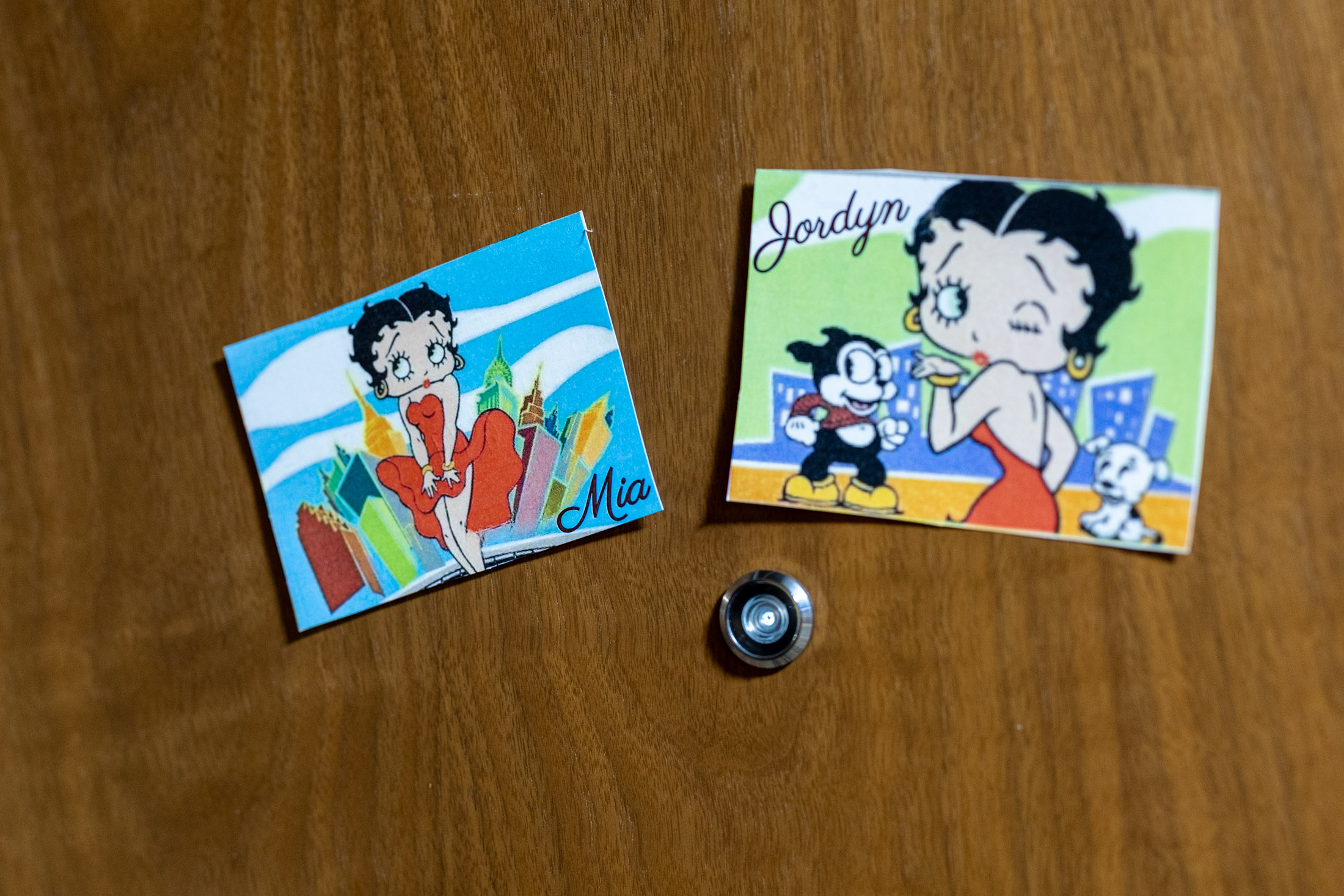
Moments later, Houston arrived and greeted Dominguez and her family warmly. Like Dominguez, she was eager to get to know the people in her hall—which was decorated in a Betty Boop theme—and participate in several Welcome Week events, including Karaoke Night, held yesterday evening in the Damen Student Center.
“I’m excited for karaoke, for making new friends, for learning,” Houston said. Mostly, “I’m excited for the independence, and the chance to learn more about what I want to go into in the medical field.”
This fall, Houston has a demanding academic schedule planned, including courses in biology, chemistry, theology, and pre-calculus. And like Dominguez, who was awarded a prestigious Presidential Scholarship, she is braced to buckle down.
Houston selected Loyola over other colleges, including the University of Illinois Chicago, DePaul University, Illinois State University, and several New York schools, because of its strong reputation in the sciences, along with the fact that “I loved the campus and welcoming people I met,” she said.
Seamless coordination
As for the check-in and unloading process, it was a breeze, said Leobardo Dominguez.
That’s thanks, in large part, to the efforts of the Department of Residence Life and student and staff volunteers. “We put a lot of time and thought into the process, including the move-in timeslots students are assigned to, staffing levels, signage around campus, and really all aspects of the process,” said Melissa Bagon, assistant director for assignments. “This takes a great deal of coordination between many offices across campus.”
Tate Franti (BA ’29), a resident assistant at San Francisco Hall who was helping direct newly arriving students and families, said the energy and excitement reminded him of his experience a year ago as a first-year student arriving at Simpson Hall, a feeling he was more than happy to relive.
“It was just this portal to a new world,” he said. “Everything was new. New city, new people, new place to live, new school. Just that sense of discovery of everything’s new.”