Share


Last fall, in the bustling, 13-block theater district of Midtown Manhattan, Broadway stage actor John Drea (BA ’20) was passing by a tour group when he overheard the guide say something that pricked up his ears.
“Artificial intelligence is going to be great for theater,” he recalled the guide telling the group. “Because AI is just going to make all the TV and film. And that means everyone will be coming to see theater instead.”
The tour guide isn’t the only one making such predictions. Screenwriter, director, and actor Ian Brennan (BA ’01), who cocreated the Fox hit series Glee and the Netflix true-crime anthology Monster, made a similar observation at a fitness center near his home in Los Angeles. Shortly after the release of Open AI’s ChatGPT, two members were showing off its writing capabilities. Brennan had to laugh.
“Literally my first thought was ‘The one thing this will not touch is live performance,’” he said. “My whole time coming up through theater, it was always talked about as a dying art. And I’m like, ‘Nope.’ Once again, it lives.”
“I’m sure you could get Claude to spit out a three-act play,” Brennan continued, “but people want to have an actual experience, and theater is built on that—the visceral experience of standing in a room and being in a space, physically in a space, where a story is being told. I think that core thing won’t be touched by artificial intelligence and will, I think, easily survive it,” he said.
If Brennan’s take seems overly optimistic, a large body of recent evidence suggests otherwise. In an age when AI is upending the literary world by generating stories and film scripts; worrying recording artists by producing Billboard hits and mimicking the musical styles of vibey artists like Drake and the Weeknd; and, according to a widely circulated Stanford University analysis, shrinking the entry-level labor market in fields ranging from software development to customer service, the performing arts are not just surviving—they’re flourishing.
A recent Goldman Sachs report projected live music to hit $43.7 billion by 2027, a 27 percent jump from 2024, and while stadium spectacles like pop superstar Taylor Swift’s record-setting $2 billion Eras tour are contributing to the upswing, they are far from the only driver. The Royal Philharmonic Orchestra reported that interest in classical and orchestral music reached its highest level in six years in 2026, fueled largely by younger and first-time audiences, with 78% of 2,000 surveyed audience members believing that AI cannot replace human creativity in live performances. Meanwhile, Broadway’s 2024–25 season was the highest grossing in its history, with 91% of seats filled.
People want to have an actual experience, and theater is built on that—the visceral experience of standing in a room and being in a space, where a story is being told
— Ian Brennan (BA '00)
Why are the performing arts booming?
“The thing that we’re starting to hear is that we have an epidemic of loneliness,” said Brooke Flanagan, executive director for the Steppenwolf Theater Company. “So staying home and doing Netflix and takeout might feel yummy and cozy, but if you pair that with a lot of work from home and you’re not going out and seeing other people or socializing, depression and anxiety start to increase. So we’re starting to see a trend of people really forcing themselves out of the house into more social engagements.”
The communal aspect of live performance is undoubtedly part of its appeal. “Going to a show, being out in public, the interactions that you have—I know there have been a lot of changes in the digital experience, but, for now, it feels like the IRL [in real life] experience is still king,” said Brent Hyl, director of music at 16” on Center, a Chicago-based company that books musicians at venues like the Salt Shed and Thalia Hall.
Breaking down the fourth wall
But the resilience of the performing arts goes far beyond its role as a social lubricant, say several Loyola University Chicago faculty and alumni affiliated with the Department of Fine and Performing Arts.
For Drea, who starred as the cold, unfeeling boss, Howard Wagner, in director Joe Mantello’s Broadway revival of Arthur Miller’s classic Death of a Salesman at the Winter Garden Theater this past spring and summer, the allure of live performance stems both from its unrepeatable, one-time quality and the visual-spatial elimination of the so-called fourth wall, the imaginary barrier separating the audience from the performers.
In a four-month string of packed performances, the audience’s vocal eruption during one of the play’s most wrenching scenes—when the protagonist Willy Loman, an aging traveling salesman played by Nathan Lane, arrives in Howard’s office and asks to be taken off the road and reassigned to a desk job, only to be cruelly rebuffed and fired—was, to Drea, a recurring affirmation of the power of live theater.
“That actual moment of staring Willy Loman in the face and saying, ‘I don’t want you to represent us anymore.’ And then hearing the collective groan of the audience, like, ‘Oh, God.’ Even though, in my head, I’m like, ‘Isn’t this kind of inevitable? Didn’t anybody see this coming?’ But it still hurts to hear,” Drea said.
“It’s a massive, massive theater, like 1,600 seats, and this is ultimately an intimate family drama,” he continued. “At first, we were worried it would get swallowed up by the size. But the big surprise from the first time we got in front of an audience to all the audiences since then, is that it’s actually the opposite. The size of the theater actually lifts the play up and turns it into a larger-than-life American myth.”
Tim Kane, an assistant professor of theater in Loyola’s Department of Fine and Performing Arts, experienced a similar feeling this past spring at the Chicago Shakespeare Theater while playing the role of Master Ford in Shakespeare’s comedy The Merry Wives of Windsor. Shakespeare, as a playwright of the Elizabethan age, Kane said, is famous for his asides, in which characters speak directly to the audience and invite them into the play as participants: to make eye contact, to laugh, and to grapple with thorny moral and philosophical questions.
“The thing about theater that makes it special is that it is different every single night because the audience is different every single night. And even on a show that is less than perfect, there are moments in a performance in which I get to feel that energy with other actors and with the audience,” Kane said. “And, here, I’ll get on my artistic, puritanical soapbox. AI can’t do that.”
While some tech-optimists might disagree, there is little dispute that live performance is deeply ingrained in the human experience. According to BBC reporter Aarathi Prasad, Charles Darwin, in his book The Descent of Man, “wondered whether our language abilities had started with singing, and if that was the reason for our pleasure in music.” Prasad notes further that our ancestors had a “horseshoe-shaped hyoid bone in the throat in a similar position to [that of] modern humans,” giving them the ability to sing more than 530,000 years ago.
This anatomical trait laid the groundwork for communal singing and chanting, often as a form of deity worship or a gateway to spiritual transcendence. In the early Christian Church, for instance, people participated actively in prayer through the communal singing of psalms, a practice inherited from Jewish tradition, says Kirsten Hedegaard, a singer, conductor, and chair of the Department of Fine and Performing Arts. Similar traditions can be traced across religious and cultural traditions, from African call-and-response songs and Indigenous ceremonial singing to participatory folk song traditions throughout Europe, Asia, and Latin America.
“You only need to tap into history and culture very briefly to see that making music together and singing together has been a part of history for many, many centuries and in all cultures,” Hedegaard said.
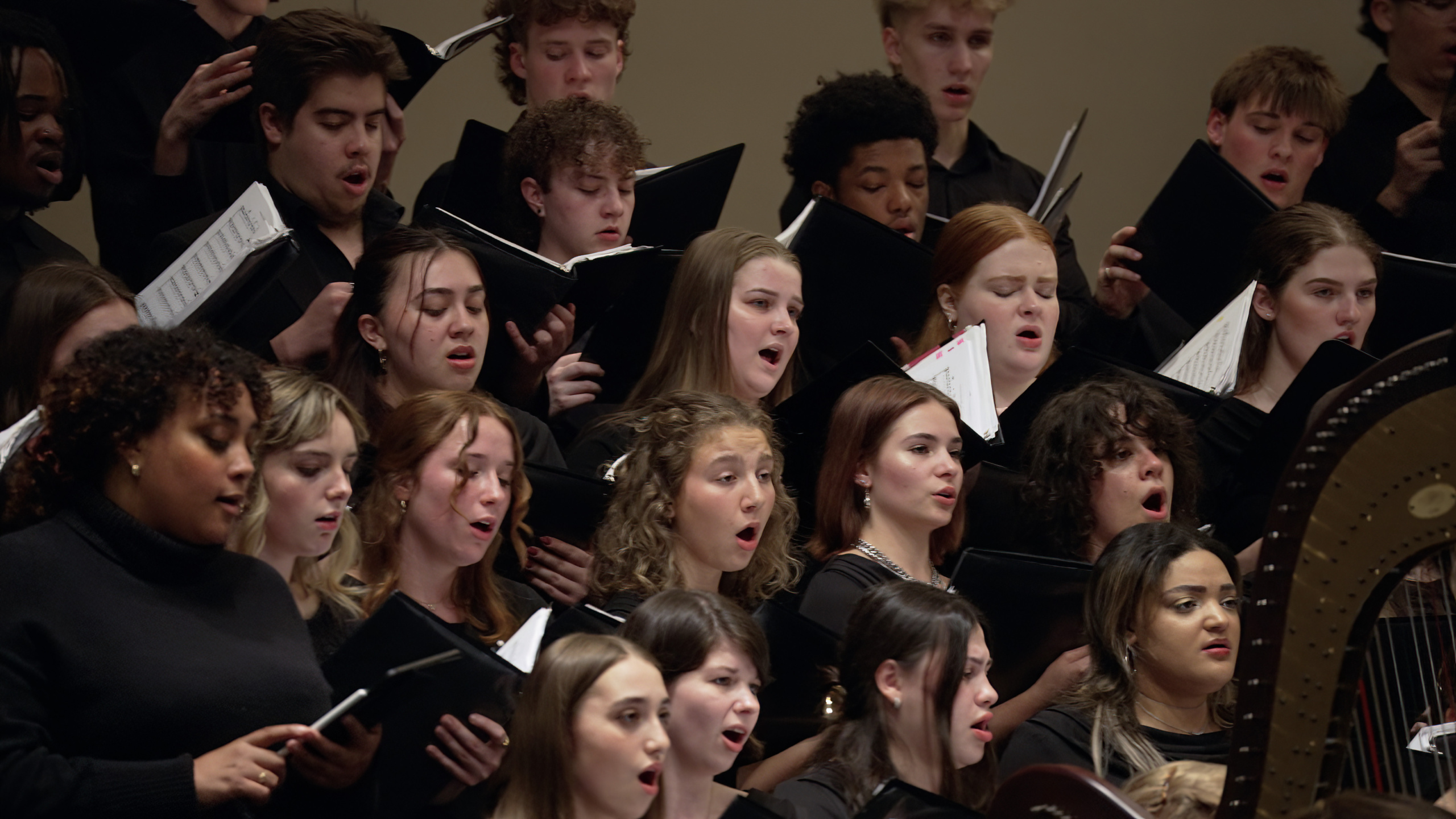
As cofounder and artistic director of the EcoVoice Project, a nonprofit that aims to inspire ecological stewardship through live performances, she has been committed to carrying on this communal tradition. This past spring, Hedegaard and Loyola instructor Jennifer Budziak codirected the world premiere of Ámmo’naka (In a Beginning), a libretto composed by Jerod Impichchaachaaha’ Tate and featuring original poetry written in Chickasaw (a language spoken by fewer than 100 people) by the poet Lokosh Hinson. Backed by a full orchestra in Jo Ann Rooney Hall, more than a hundred student singers in three Loyola choirs performed the work, which Hedegaard says speaks to the enveloping, reverb-drenched quality of live acoustic music.
“This music has never seen or heard the light of day. And so for our Loyola students to start from basically nothing and then create this incredibly important large work to be shared with our audience is in itself a thrill.”
“When you hear music on a recording like on Spotify,” Hedegaard continued, “it’s still pretty cool, but there’s a veil that prevents the full experience, because you’re not feeling the in-person vibrations. So, minimally, having the opportunity for people to be in the space of vibrating voices and vibrating instruments is, scientifically, very healing. I mean, you go to see Beethoven’s Fifth Symphony with a good symphony orchestra, and it’s like, ‘I had no idea people, humans, could make that happen.’ It’s mind blowing.”
Scientific evidence suggests, moreover, that watching a live performance is fundamentally different than viewing the same performance on a screen.
A 2025 study in France evaluated the reactions of 27 people who, in a small theater, watched five-minute live and recorded video performances combining dance, singing, and guitar. Data from self-reported questionnaires, electroencephalogram headsets, and electrodermal activity sensors, and photoplethysmography devices showed the live performances evoked stronger emotional and physiologic responses than the videos. “These findings underscore the unique role of live performances in human emotional experience, highlighting the importance of direct performer-audience interaction,” the researchers concluded.
Emerging legal rulings related to AI-generated content are also likely to support the resilience of live performance. In the seminal Thaler v. Perlmutter case in May 2025, the U.S. Court of Appeals ruled that copyright protection can only be granted for works created in the first instance by human authors. This extends to works companies acquire from third parties and potentially implicates organizations that source and publish AI-generated material scraped from “dark libraries” of books, plays, and poems on open-source platforms without the author’s consent.
“For those two reasons, I think we are a long way off from AI replacing costume designers, set designers, playwrights—any of the creative industry side of our business,” Flanagan said.
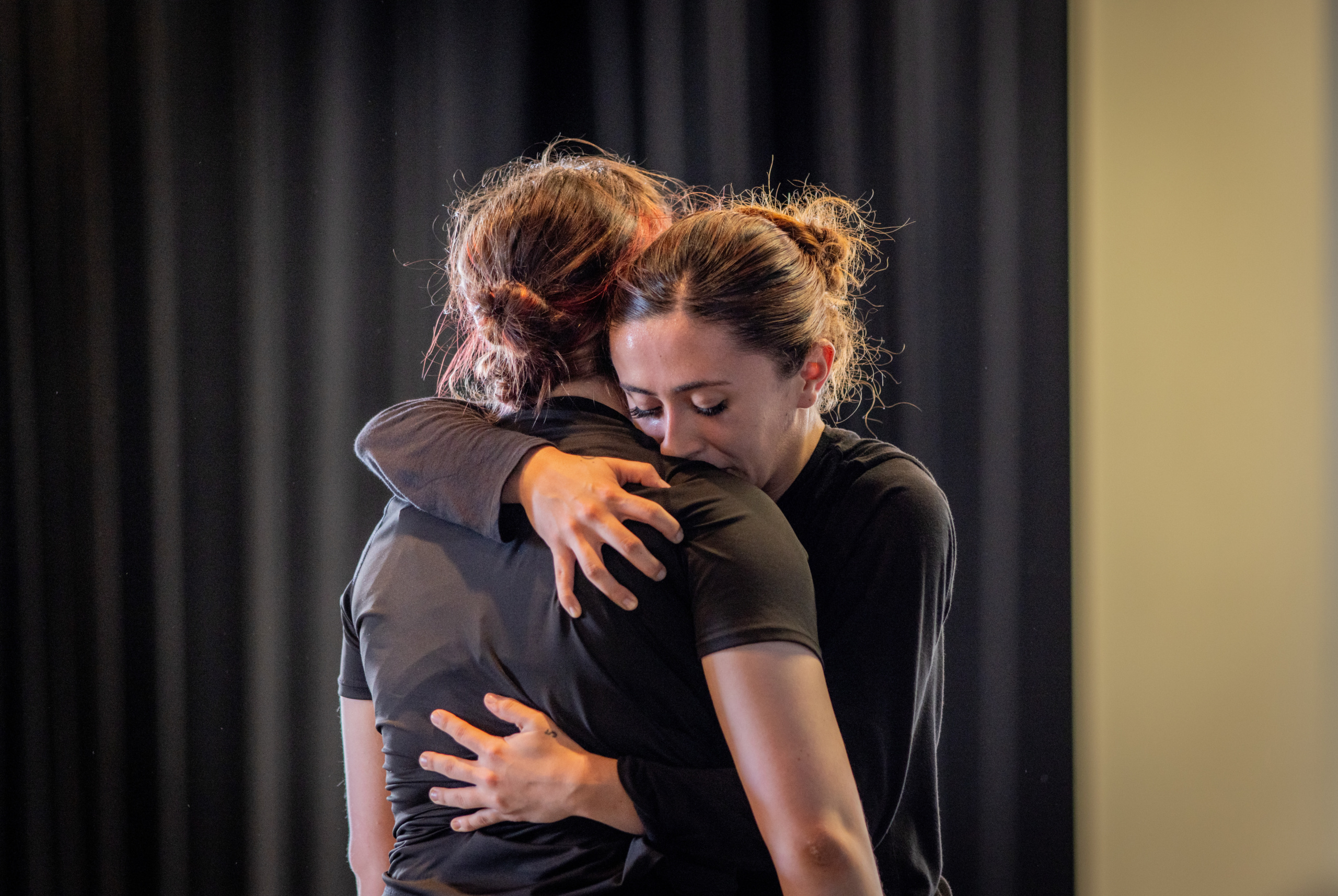
Preparing for a multi-hyphenate future
Still, the broader arts community that contributes to live and recorded productions is not immune to the effects of digital encroachment. Brennan has seen Hollywood writers’ rooms shrink to four to five people, down from more than 20 during the height of shows like The Simpsons and Family Guy, as research roles have been farmed out to AI. Non-acting creative roles at Chicago storefront theaters for set designers and marketing positions are also thinning out.
“I’m seeing AI being used to replace jobs that could be done by an actual human being. So it’s starting. I don’t think the theater is immune from it, even if actors on stage are,” Drea said.
Work for studio musicians might also be at risk. “The live version of it feels safe, but at some point, you’ve got to wonder about somebody putting out an ad and needing that quick version of a style of music. If they can just dial it up using AI, what does that do for folks that rely on studio work?” Hyl said.
And while sales have been strong at small 100–400 person clubs and large venues like The Salt Shed, whose outdoor fairgrounds can host 4,000–5,000 people, mid-sized venues like Thalia Hall are feeling the pinch of rising inflation and digital alternatives. Flanagan says the sales picture at Steppenwolf has also been a mixed bag, with promising increases in single-ticket attendance for plays and education programming offset by a post-pandemic dip in subscriptions.
Yet for Loyola alumni who have gone on to successful performing arts careers, the educational focus of the Department of Fine and Performing Arts—blending ensemble productions, diverse artistic skill development, and career mentorship—appears to be paying off handsomely.
“What was really instilled at Loyola was ensemble work and the value of this team that you’re working with,” Drea said. “That’s a valuable perspective that has, I think, protected me from getting too in my head as I’ve started to work at Steppenwolf and Broadway.”
“The irony’s not lost on me,” he continued, “that all during high school and college, and even now sometimes from friends, from family, from media, you hear ‘You’ve got to be responsible and you’ve got to get a real job.’ And now, in 2026, we’re looking at a potential future where this career that is still risk…is hard to be replaced.”
DeRon Williams, an assistant professor of theater and freelance dramaturg and director, expressed a similar view. He said current Loyola performing arts students will continue to thrive in the age of AI “as long we do our job in the Department of Fine and Performing Arts of not abandoning the classics, not abandoning the foundational training, but also of incorporating new ways of existing in 2026 and beyond.”
Part of that new model involves catering to younger, more diverse audiences who prefer “political, socially leaning content,” even if it’s adapted from canonical works by playwrights like Tennessee Williams and Henrik Ibsen. But even more important, he said, is offering students opportunities to diversify their artistic skill sets.
“I’m working as an associate director at Timeline Theater on Henrik Ibsen’s Enemy of the People, which is the first production in their new space,” Williams said. “Some of the artists in the room are working as producers for their own independent theaters. They’re also acting. They’re also helping with props on someone else’s production, but they’re always working and exercising a variety of muscles.”
“So I tell my students to learn all areas of the art,” he continued, “to really engage in Loyola’s broad liberal arts curriculum of experiencing how to be a designer, as well as a director, as well as an actor, and so forth, because you never know what avenue will take you to the rehearsal room or to that next big thing.”
Flanagan says that’s a particularly valuable lesson in an increasingly fluid professional landscape, in which artists are less bound by roles and titles: “We’ve been telling our stories on stage for thousands of years. We’ve always been a cornerstone of our democracy and a way for us to continue that very primal urge to gather around the fire and tell our stories to one another. I think the cool thing about theater, American theater in 2026, is we have more room for artists to be multihyphenate, which is to say to pursue a career wherein you are not boxed into being an actor or a playwright or a director, but to have fluidity among those.”
It's almost like live performance is less performative than what you're seeing online. It's so much less curated, and it's so much messier, and I think that's exciting to people.
— Alix Schillaci (BA '16)
Alix Schillaci (BA ’16), a performer, choreographer, and director who has created and staged the dance theater works Sunset’s That Way, Cannonball, and Dream Machine, embodies such artistic dynamism. Grants, residencies (including a current one at bim bom studios), and commissions help her pay for studio space to host auditions and rehearsals for her productions. Her role as a full-time senior pointe shoe fitter and e-commerce manager at Allegro Dance Boutique in Evanston covers her bills and living expenses. She also performs as a burlesque and heels dancer, teaches master classes in dance at Loyola, and designs sets for television commercials, including those produced by Potbelly, Pop Secret, nutribullet, and the Chicago Humane Society.
It’s a full schedule, but it’s work she loves, and at least for now, she’s not worried about being upstaged by a troupe of dancing robots.
“I’ve felt very encouraged lately with sold-out shows, and I know my friends have been having successful shows, too. So there’s definitely an interest and an excitement I didn’t feel a year ago,” she said. “It’s almost like live performance is less performative than what you’re seeing online. It’s so much less curated, and it’s so much messier, and I think that’s exciting to people.”