


Share


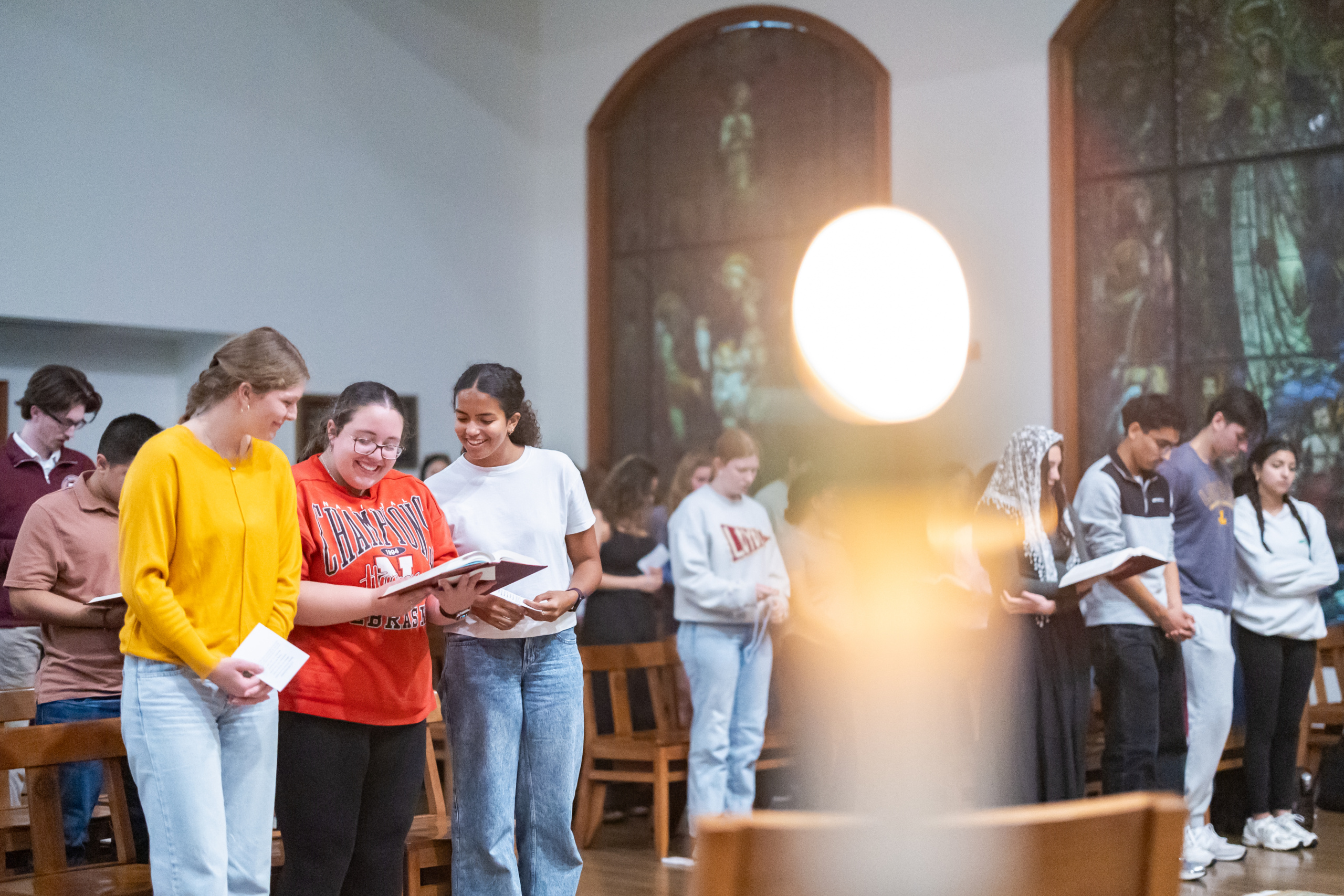
Hours after darkness had fallen over Lake Shore campus, three roommates arrived at Thursday night Mass at Ignatius House. They sat side by side in a second-floor chapel, with potted olive trees flanking a wooden crucifix, a tabernacle, and a tall arched window. It’s a good thing they came early—well before the 9:00 p.m. start—or they might not have found a seat. A Catholic wave is sweeping across college campuses these days, and the 70 seats at Ignatius House fill fast.
Luis Becerril (BBA ’27), who performs duties as an altar server at Madonna della Strada Chapel, explains his reason for coming in faith-based terms: “There is a deep calling to always serve the Lord,” he told me. “Sunday is a reserved, obligatory day to go to Mass, but that shouldn’t be the only day we go.”
Seated beside him was Thong Nguyen (BBA ‘26), a private banker at J.P. Morgan Chase. Born in Vietnam to a Buddhist father and a Catholic mother, Nguyen befriended Becerril in a Loyola University Chicago sociology class. As the two became closer, Nguyen’s commitment to Catholicism deepened. He registered for the Order of Christian Initiation of Adults (OCIA), a nearly year-long series of religious classes that culminated, in April, with his baptism and initiation into the Catholic Church at Madonna della Strada. “I’m grateful that I was brought in by that wonderful friend [Luis] who became my godfather as well,” he said.
Then there was Levi Atang, a senior at the University of Illinois who recently moved into a Rogers Park apartment with Becerill and Nguyen. Atang is not Catholic, nor even particularly religious, but when Nguyen ditched his gym plans to attend Mass and threw out an invitation, Atan decided to tag along.
“My dad was a pastor, but I’ve always been skeptical when it comes to religion,” he told me. “I’m still skeptical, but I guess it’s kind of foolish to be a skeptic from the outside without going in to learn more.”
“Literally, it’s a chain reaction,“ Becerril said.
A Catholic revival on college campuses
The contagious effect of Thursday night Mass reflects Loyola’s distinct Jesuit, Catholic focus and a surge in Catholicism among college students across the country. Young men in their 20s and 30s are flocking to the Church in search of purpose and meaning. Social justice has become a rallying cry for many young Catholics. And chronically online students are seeking fellowship and connection in IRL communities. In fact, data from the Christian prayer app Hallow shows OCIA participation across the country has more than doubled from the 2024-25 school year to 2025-26, showing 115 percent growth in a single year.
For all these reasons—and perhaps, above all, the friendships that have grown out of it—the service has become increasingly popular. “Here on Thursdays, we have chairs for 70 and, depending on what point it is in the semester, we might have 15 people sitting on the floor,” said Fr. Michael Rossmann, S.J., the Superior of the Jesuit Community at Loyola who presided over the Mass.
Hosted weekly by Loyola’s Jesuit community throughout the academic year, the Mass includes prayer readings, hymns, a homily, and the celebration of the Eucharist, the dominant sacramental rite of Catholics, in which parishioners eat bread and drink wine—the Body and Blood of Jesus—to honor Christ’s sacrifice and presence in their lives.
“We help to build a community where we take Jesus Christ seriously, and we’re not ashamed of that and we can support each other in that,” Rossmann said during the service. “We’re not alone. And friendships formed here can help us stand firm long after we leave this chapel.”
While the Thursday night Mass is notable for its student focus and location in the Ignatius House—where 19 of Loyola’s 30 Jesuits live, nearly all of them studying at Loyola or working in University roles ranging from chaplains to professors—it isn’t the only Catholic service at Loyola drawing crowds of young people.
“I see more and more students going in the morning [to Madonna della Strada] and that has been a fascinating development,” Rossmann said. “That does not match my experience when I was in college.”
Seeking stability in a shifting world
Why are so many young people embracing Catholicism and turning up for Mass?
“I wish I could explain it all,” Rossmann said. “I think, on some level, people are looking for some firm foundation. People are attracted to some sense of tradition, something stable in a world in which there is just so much shifting.”
“For some young men,” he added, “church can be a space where it feels perfectly fine to be a man. I think there are some other spaces where, maybe, it doesn’t always feel great to be a guy.”
Creating an inclusive environment where a range of religious views can peaceably coexist is one of the challenges Rossmann embraces in his roles as a Jesuit priest, University chaplain, and adjunct professor of theology. He often broaches topics, like fear of commitment, that hold sway among a Gen Z crowd.
“Even if I am preaching on the same readings, it’s going to look and sound somewhat different when I’m here on campus than when I’m at a parish where you have people of all ages,” Rossmann said.
The Superior’s cultural fluency was on vivid display Thursday night. In a relatable homily with frequent touches of humor and pop culture tags, Rossman wove together a letter from St. Paul to the Ephesians and the historical narrative of Stephen Tomislav Poglajen, a Croatian-born Jesuit priest, who, in 1943, fearing Communist persecution during World War II, organized college students “into small groups they called ‘The Family.’”
“On Sunday mornings they would come together for Mass and breakfast and discuss their faith and what was happening in the world,” Rossmann said. “It sounds a lot like the Christian Life Community or A.M.D.G. community [student religious groups at Loyola], but they probably had less Raising Cane’s back in Slovakia in the 1940s.” (Laughter echoed through the chapel; the fast food company’s chicken is popular at A.M.D.G. and Christian Life Community events).
‘“A faith group like that is not exactly the first thing that comes to mind when you think of preparing to resist a dictatorship,” Rossmann continued. “But when the communists seized power a few years later, members of these communities helped sustain the underground church. Some were willing to go to prison for it. And their courage didn’t suddenly appear. They had been growing it for years alongside friends who supported them and challenged them.”
A socially savvy storyteller who posts a weekly “One Minute Homily” on Substack, Rossmann seemed to understand the tastes of his audience. At one point, he drew on a viral YouTube meme of a testy honey badger to interpret a story in the Gospel of Luke. In the story, Christ compares himself to a hen—the message being that Jesus’s strength in the face of a death threat from the 1st-century Roman ruler Herod Antipas, whom Jesus describes as a “fox,” is protective and divinely given, rather than predatorial.
“I don’t know, If I had to choose an animal to face down a fox, I’d probably go with a lion, maybe a honey badger. Honey badger don’t care,” Rossman said. “But a chicken? And yet, when a predator approaches, a mother hen gathers her chicks beneath her wing, puts herself in between them and whatever is coming. She’s maybe no match for a fox, but she’s able to protect those under her care.”
‘A miracle in itself’
After the service, students gathered in the first-floor reception hall, where cookies were laid out on a serving table near a statue of Ignatius of Loyola, the Spanish priest who founded the Society of Jesus. Many students spoke with Jesuit brothers, scholastics, and priests who joined them to nosh and socialize.
Among them was Gabbie Taglia (BA ‘27), a former atheist who converted to Catholicism after meeting Jesuits at Loyola whose willingness to “be with people on the margins of society” impressed her. “I would have never converted if I was in a hardcore, traditional order, where I couldn’t be fully myself,” she said. “I’m a queer person, and I really care about that aspect of my identity. And I think if I was anywhere else, I might have been shunned in a way that wouldn’t be healthy for me.”
Since becoming Catholic, Taglia has made a habit of attending Masses at parishes across Chicago.
“I feel like it gives me somewhere to anchor my values in a really concrete way,” she said. “I have a lot of strong feelings about things, and I care about social justice a lot, and now I have a really strong rooted reason to. God created this earth and loves us all so deeply, and that’s such a beautiful reason to care about each other and care about the world.”
The Mass also struck a chord with Nguyen, but for a different reason—the Catholic Church’s traditional worship style, rooted in a 2,000-year-old history, appeals to him in a way he finds lacking in the looser approach of non-denominational Christian churches.
“The idea of once saved, always saved, was something that I liked, but then as I did more research and started looking into what non-denominational Christianity was, it’s clear it wasn’t rooted in history,” Nguyen said. “And so, that’s when I started saying, “What’s the oldest church? What were they doing around 100 A.D. and so on.”
If students’ understanding of Catholicism and the reasons they embrace it vary widely, events like Thursday night Mass offer a big tent for divergent views—and a community where friendships can take root.
“At first, I was really only coming for the social aspect,” said Kamila Chavez (BA ’27), a leader of the Spanglish Christian Life Community and undergraduate research assistant at the Hank Center for the Catholic Intellectual Heritage. “I thought, ‘I need friends, so I’m going to sit through a Mass and then talk to people after. But I think, honestly, Thursday night Mass is a little bit of a miracle in itself. This group of 18- to 20-somethings just dropping everything in the middle of the week and wanting to spend time together, but also with Christ and to receive the Eucharist and not have to wait until Sunday to do it.”


