They teach. They research. They serve the greater good. Meet Loyola’s Jesuits.
November 19, 2026
Share


“There’s an expression that if you’ve met one Jesuit, you’ve only met one Jesuit,” says Father Michael Rossmann, S.J., the Superior of the Jesuit Community at Loyola University Chicago.
It’s a colorful way of saying Jesuits are a remarkably diverse group. Founded in 1534 by St. Ignatius of Loyola, the son of a Spanish royal family, and a small group of his companions, the religious order of men within the Catholic Church devote themselves to serving God and the greater good.
Guided by the Universal Apostolic Preferences, Jesuits focus on serving young people and marginalized groups, caring for the earth, and providing spiritual accompaniment to those seeking a deeper relationship with God. In a formation process that can last more than 15 years, they are trained in Ignatian spirituality, make a 30-day silent retreat, take extensive graduate studies in philosophy and theology, and perform active ministry at schools, parishes, refugee camps, and retreats around the globe.
At Loyola, 30 Jesuits live on campus in religious communities at Ignatius House, Arrupe House, and Hopkins House. Representing diverse ages, national origins, and stages of formation, nearly all the Jesuits living on campus work or study at Loyola in roles ranging from chaplains, to priests, to professors, to University leaders.
But perhaps the best way to understand Loyola’s Jesuit community is through their stories.
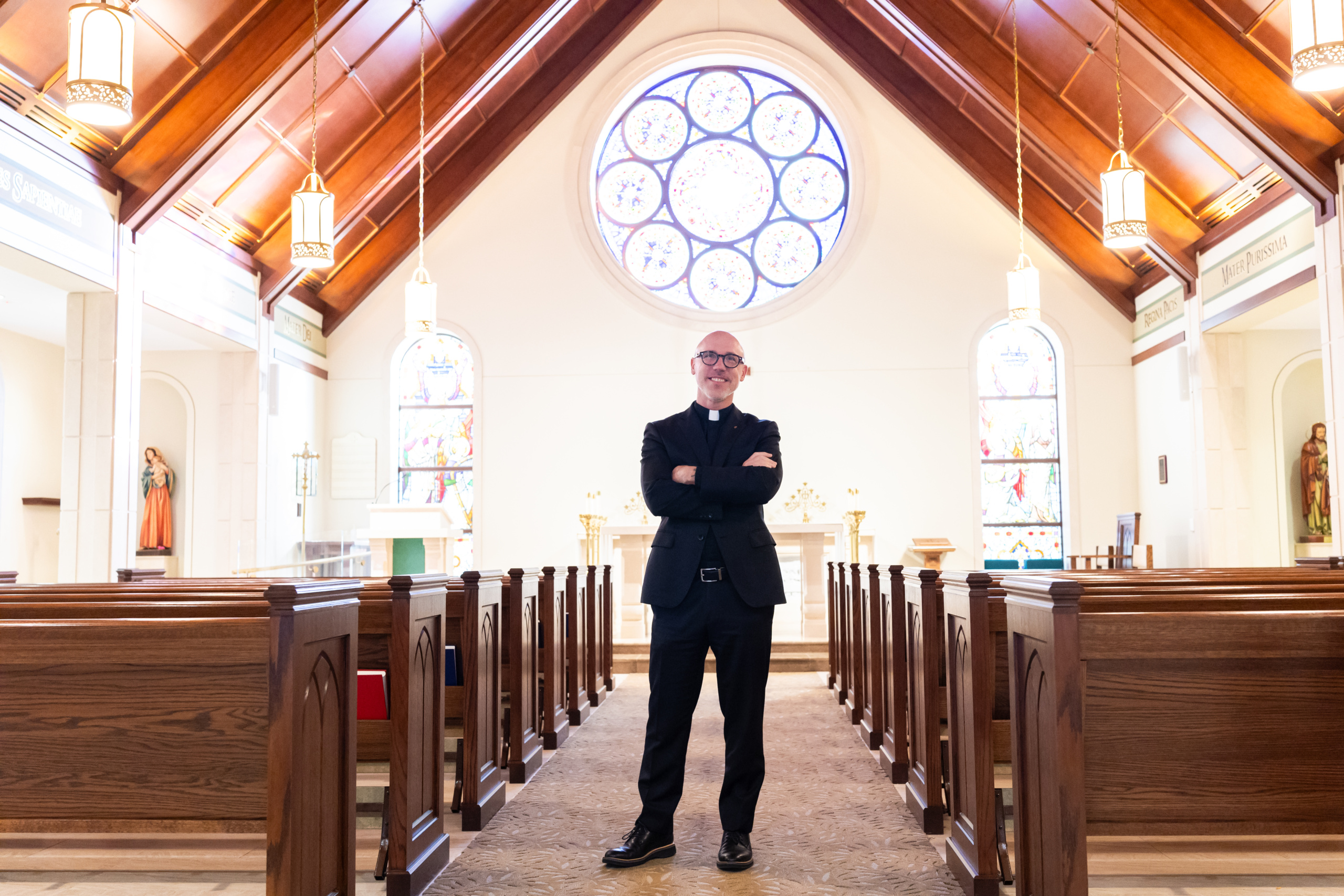
Rev. Patrick Gilger, S.J. (MA ’07)
The Kingfisher
Rev. Patrick Gilger, S.J., is a Bob Dylan superfan, and his favorite quote from the legendary songwriter—“I am my words”—preserved in a 1963 Newsweek profile, echoes his view of his role as a Jesuit priest.
“It speaks to the real gift Dylan gives, which is less himself than the willingness to get out of the way of what’s moving through him,” Gilger said. “It reminds me of a lot of what I do as a priest: get out of the way so God can act.”
Gilger is an assistant professor of sociology who directs the McNamara Center for the Social Study of Religion at Loyola. An ordained priest, award-winning author, and contributing culture editor at the Catholic magazine America, he is a frequent media commentator who has appeared on CNN, Fox, NPR, and many podcasts.
Born in rural, upstate Minnesota, Gilger moved with his family across the country, following the ascendant career path of his mother, Kristin Grady Gilger, a newspaper editor who worked at several city papers, including the Times-Picayune in New Orleans, before eventually becoming a senior associate dean and professor at the Walter Cronkite School of Journalism and Mass Media. In 1998, at his mother’s urging, Gilger enrolled at Creighton University. His experience at the Jesuit university was revelatory.
“My mind was really opened and invited to imagine what the world might be,” he said. “Before going to Creighton, I had never met people—lay people or Jesuits—who were both unafraid and interested in the world, curious about reality and had read everything; had read Friedrich Nietzsche and Karl Marx and Michel Foucault and Sigmund Freud and were completely unafraid of this kind of thinking and learning about the world.”
One day, a friend invited him to attend a Mass, and the experience touched a chord. “In the quiet and the darkness of that place of prayer, something was happening,” he said.
As he began to learn more about the Jesuits’ involvement in peace activism, his interest in the Society of Jesus deepened. Particularly affecting was the story of six Jesuits priests, their cook, and her teenage daughter, who were killed by U.S.-trained soldiers in the Salvadoran Army during a 12-year civil war between the left-wing Farabundo Martí National Liberation Front (FMLN) and the El Salvadorian government.
“I remember finding out that the Jesuits had been killed at the University of Central America in San Salvador in 1989, and I was a freshman in college in 1998, and I was like, ‘Wait a minute, wait a minute,’” Gilger said.
“‘These guys were killed nine years ago? What are you talking about?” he went on. “This is impossible. I had in my head that the age of martyrdom was something that happened in the 400s, and I thought, ‘This was nine years ago.’ These guys were pulled out of their bedrooms and shot in the garden outside their house. So all that stuff was deeply intertwined—the idea of sacrifice and working for justice in the world.”
With a group of friends, Gilger began preparing meals for local unhoused people and volunteering at a predominantly Black, Catholic school in Omaha, Nebraska. He found purpose in serving others.
“So I entered the Society of Jesus right after college, not sure that I was going to be a Jesuit, but because that vision was hypnotizing and I couldn’t get away from it, I had to test it out,” he said. “Early on, I think part of me was hoping God would say, ‘Thanks for trying. You can go get married now and have a family.’ And as I calmed down and got more stable in my own sense of identity, and more patient, my heart was more open.”
Perhaps the biggest ‘lesson’ is that the Church is much bigger than America. What I mean is its concerns are bigger. Its history is longer. It is more flexible with how it includes people. And its vision for the world is grander, humbler, and more hopeful than the vision of reality that comes to us easily as Americans.
— Rev. Patrick Gilger, S.J.
Since joining the Society of Jesus in 2002, Gilger has undergone more than a decade of education and theological training. During his formation, he taught courses at Marquette University High School in Milwaukee and the Pine Ridge Reservation at Red Cloud Indian School in South Dakota, earned his master’s degree in philosophy at Loyola, studied theology at Santa Clara University, and received his doctorate in sociology at the New School for Social Research in New York City.
In summer 2005, while earning his MA in philosophy at Loyola, Gilger journeyed to India to work alongside the Jesuits of Kohima Province in the northeastern state of Nagaland. “I lived in one of the parishes in the middle of the jungle and visited the remote villages and spent time with the people—listening to them and praying with them—and taught in our schools,” he says. Gilger has also done missionary work in South Sudan, where he worked in schools run by the Jesuit Refugee Service, said masses at local parishes, and ran peacebuilding exercises for political and religious leaders.
“There are many stories, but perhaps the biggest ‘lesson’ is that the Church is much bigger than America,” he told me. “What I mean is its concerns are bigger. Its history is longer. It is more flexible with how it includes people. And its vision for the world is grander, humbler, and more hopeful than the vision of reality that comes to us easily as Americans. I don’t mean that America is bad — it’s not; it’s wonderful. But the vision of reality—and of ourselves, and of God—that America allows is constrained in ways that we’re not even aware of.”
Today, Gilger lives with eight other Jesuits in Arrupe House and teaches undergraduate and graduate students in courses such as the Sociology of Religion, Sociological Theory and Spiritualities in a Secular Age. He can speak at length about Foucault, Dylan, the Milwaukee Brewers, or the future of the Catholic Church—with an intellectual depth and fervor he attributes to his Jesuit education. He brings this expansive knowledge to the classroom.
“The students that I teach, sociology majors, almost none of them practice any kind of religion. Very few of them are Catholics,” he said. “And they’re often people who would, for very understandable reasons, often of racial or gendered exclusions, find themselves on the outside of religious experience or religious institutions. And so, for me, to get the chance to be in the room with them and just think with them about their lives and the social world that they live in, I really love.”
To help connect and enrich students interested in Catholic tradition, Gilger, in partnership with Naomi Fisher, an associate professor in the Department of Philosophy, and the Department of Residence Life launched the Kingfisher Living Learning Community, a group of 15 first-year students who live together in St. Joseph’s Hall, meet for Tuesday night dinners, and attend Mass, service events, and evening talks on theology, philosophy, sociology, art, and literature.
“The Kingfisher name comes from a famous poem by a British, Jesuit poet, Gerard Manley Hopkins, and his poem is called “As Kingfishers Catch Fire,” Gilger said. “It’s about how God’s presence is known in these small sensory experiences that we have in the world—the way sounds echo or the way the light catches a bird’s wings”
Gilger is also at work on a book, The Subject of Public Religion, under contract with Notre Dame University Press and scheduled for release in summer 2027. Drawing on philosophical and sociological scholarship Gilger conducted at the New School for Social Research, the book examines how religious practices shape democratic citizens.
But of all the ways Gilger serves the Loyola community, he considers the ministry and sacramental work he does as a campus priest his highest calling. “It really involves being present in a certain way, listening to people when they’re struggling, being attentive to my colleagues or to staff or faculty members.”
On the second and fourth Tuesday of each month, Gilger says Mass at a chapel in St. Joseph Hall, which once served as a dormitory for the seminarians of the Archdiocese of Chicago. He also shares preaching duties at a 9 p.m. Sunday student Mass at Madonna della Strada with Associate Professor of Philosophy Matthew Dunch, S.J., and Michael Rozier, S.J., an associate professor of healthcare administration and vice provost for strategic initiatives at Loyola.
“I really think that the thing I am interested in is God, but that doesn’t mean some amorphous spirit that is disconnected from the world, but instead, as in the Hopkins poem, a God that is visible, tangible, and accessible through the material contact, experiences, places, and people of the world. I want to see him and find him and be in contact with him in any way that I can. And that’s the thing that I find life-giving.”
Brother Mark Mackey, S.J. (MA ’20)
The Seer
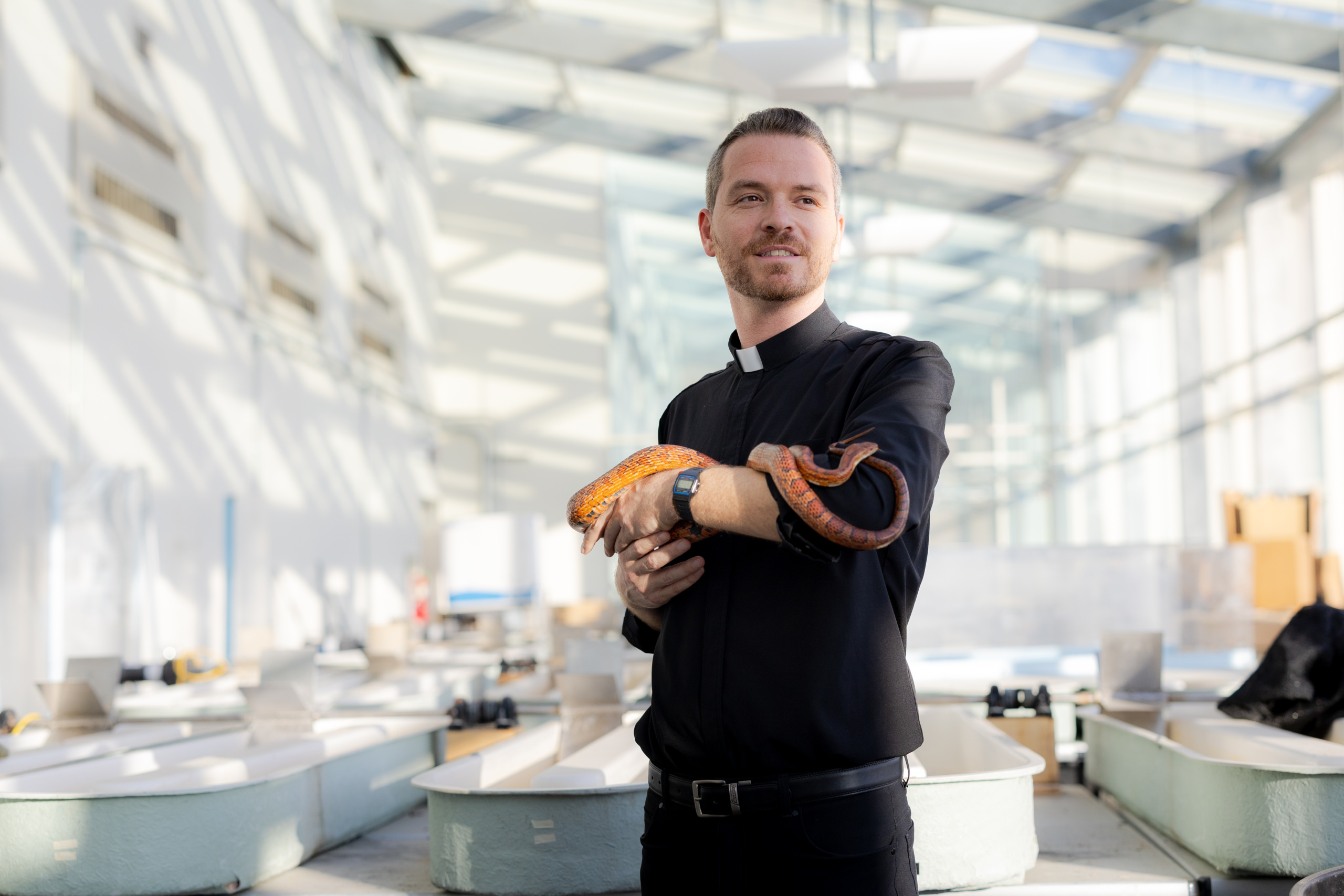
Brother Mark Mackey’s, S.J., Jesuit identity sits at the crossroads of ecology and spirituality, two lifelong passions he views as deeply connected. “They are both about learning to see in a new way,” he told me.
For Mackey, a teaching associate professor in the School of Environmental Sustainability, seeing the world clearly—with understanding and compassion—requires more than visual perception; it is cultivated practice that involves being present and sharply aware of one’s surroundings.
Having grown up in a nature-loving family outside Cincinnati, Ohio, Mackey was attuned to the habits and behaviors of plants and animals from a young age. On hiking and camping trips, he and his siblings explored creeksides searching for snakes and salamanders. “I just had that innate interest that I think a lot of young kids have, but I had adults that helped to feed it and cultivate it through not only books, but actually getting out there,” he said.
At the same time Mackey was looking outward, he was also turning inward. Raised Catholic, he attended the Jesuit-run St. Xavier High School. At first, the significance of the prayers and rituals slipped past him. But many years later, as a graduate student at the University of Missouri, his faith began to germinate—and to do so, in nature.
While pursuing his master’s in biological sciences, Mackey spent five field seasons at Highlands Biological Station in the southern Appalachian Mountains, where he investigated the environmental impact of golf courses on stream salamanders. His research revealed that habitat manipulation—channelizing streams, planting and mowing turf lawns—posed a threat to salamander populations. But it taught him something else: the value of consensus building.
“It was a really good lesson for me, because if you just went in there with the attitude a lot of people have, especially environmentalists, of ‘Hey, these [golf courses] are bad, and we need to stop them,’ nobody’s going to collaborate with you,” Mackey said.
Instead, Mackey took a conciliatory approach, encouraging golf course superintendents to adopt more sensitive land management practices, and many relied on his research to update their maintenance protocols. Yet, while the project convinced Mackey that hard scientific data can affect change, it also showed him the limits of empiricism to shape public perception.
“The top environmental issues we face are greed and apathy,” Mackey said. “To address those concerns, we really need a spiritual and a cultural transformation, and that’s not what scientists do. So that led me to a new path, which, I didn’t realize at the time, was the Jesuits.”
In 2015, energized by his newfound purpose, Mackey entered the novitiate of the Midwest Province of the Society of Jesus in St. Paul, Minnesota, and underwent a 30-day silent retreat at the Ignatian Spirituality Center in Guelph, Canada. His engagement with the Spiritual Exercises—a series of prayers and reflections developed by St. Ignatius of Loyola that ask supplicants to deeply imagine themselves in the Gospels and roughly map Jesus’s life—affirmed his calling to become a Jesuit brother.
The top environmental issues we face are greed and apathy. To address those concerns, we really need a spiritual and a cultural transformation, and that's not what scientists do.
— Brother Mark Mackey, S.J.
Unlike Jesuit priests, Jesuit brothers do not administer sacraments or say Mass, but they do take the same vows of poverty, chastity, and obedience and live in religious communities. “If you think about the term father, people relate a little more vertically to priests,” Mackey explained. “Whereas brother is a term that’s a little more horizontal, more of a side-by-side companion. And I think that’s one of the things that characterizes the vocation.”
At Loyola, Mackey performs a range of functions. He is a spiritual director for students, faculty, and staff undergoing the Spiritual Exercises in Everyday Life, an adapted form of the Spiritual Exercises spread across several months. He also leads the Eco-Warriors, an eco-anxiety support community that meets weekly and provides space for students to air anxieties surrounding climate change and develop practical responses.
“Pope Francis said, ‘anytime ecological conversion happens, it’s never individually; it’s in a community context,’” Mackey said. “That’s something we do well in our group.”
Mackey’s Jesuit calling extends to the classroom, where he applies an ethic of ecological responsibility (“care for our common home” is one of the four Universal Apostolic Preferences) to the environmental science courses he teaches, including The Scientific Basis of Environmental Issues and Ecospirituality.
“What I’m helping my students do, I hope…is being aware, in the first place, not just walking past stuff, but noticing the birds, the trees, the sky, the lake,” he says. “And not just seeing a tree for how much money it’ll make, but seeing it as having inherent value.”
This past May, Mackey traveled to northern Peru with Paula Skye Tallman, an assistant professor of anthropology, and several Loyola students as part of a multi-year research project to improve water access and implement gender equality programming in the rural education network of Fe y Alegria, a Jesuit nongovernmental organization.
In an arid region ravaged by climate change, the team’s work—slated to be featured in a forthcoming documentary produced by the Archdiocese of Chicago—is leading to meaningful action. Inside schools where it is not uncommon for a student to go an entire day without access to clean drinking water, Peruvian students and teachers are drawing on principles of integral ecology to advocate for improved health and sanitation conditions.
Loyola students in Mackey’s Ecospirituality class helped design curricular modules as part of the project, which Mackey presented on in Rome at the 2026 International Sustainability Conference, “Responding to the Cries of the Earth and the Poor.”
Like much of Mackey’s work, the project points to an interconnected way of seeing the world and responding to social and ecological crisis. “Humanity has tried to fight against the idea that we’re creatures from nature and reliant upon it,” he said. “And what we’re doing is re-adjusting our focus. We, too, require fresh air and water, and we’re part of ecosystems. And if you’re doing that the right way and following it all the way through cosmology and ecology, you’re helping to inform what it means to be human.”
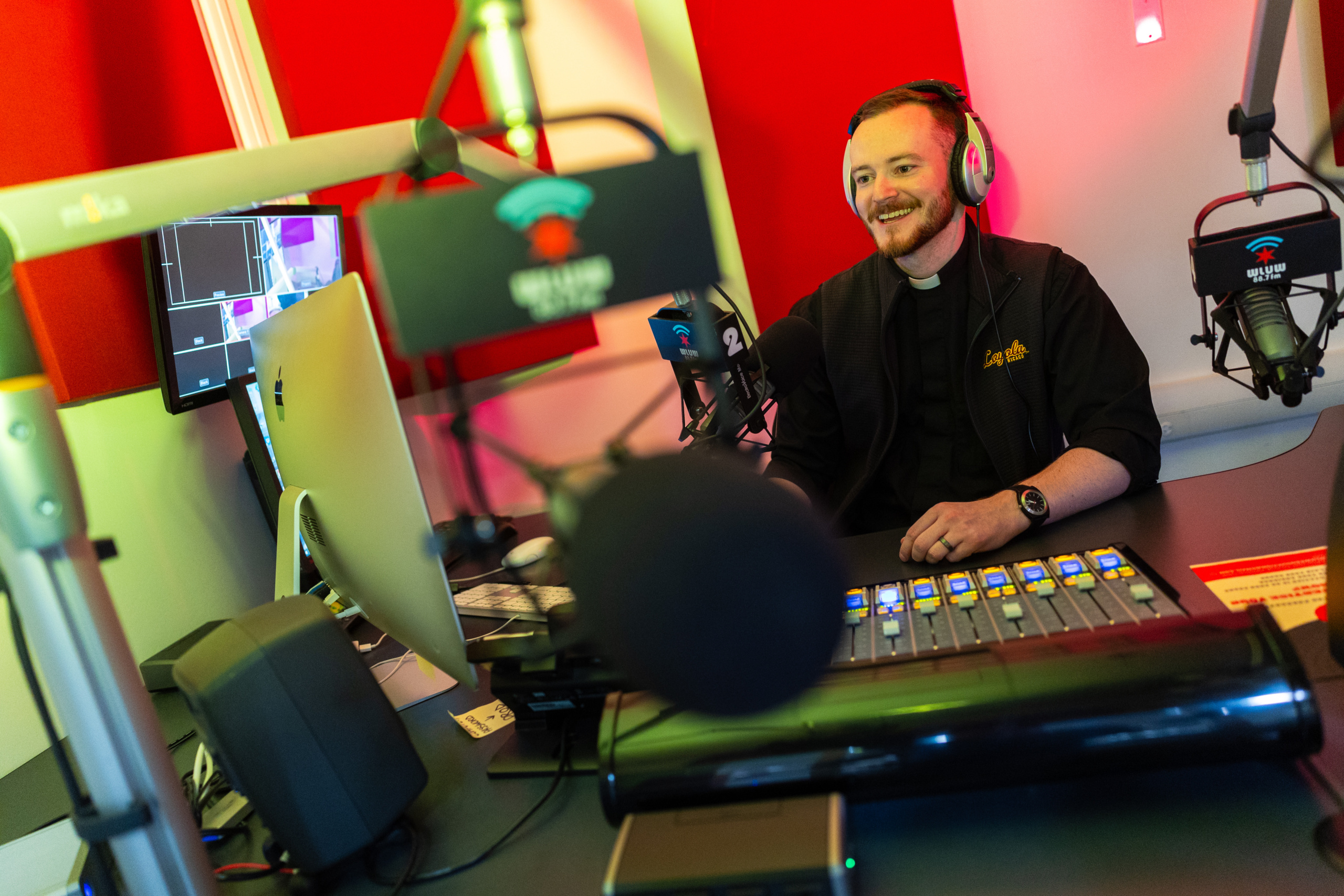
Noah Banasiewicz, S.J.
The Messenger
Noah Banasiewicz, S.J., was sitting in a conference room in America magazine’s midtown Manhattan office with a group of writers and editors glued to their laptops. He’d recently come on as an editorial intern, and it was a busy time for the Catholic monthly. Pope Francis had died a few weeks earlier on Easter Monday and speculation was swirling as to who would emerge from the conclave as the next Pope.
Back then, Banasiewicz, a lecturer of human communication and digital media in the School of Communication, was pursuing an MA in public media at Fordham University as part of his Jesuit formation. Many of his hours, however, were spent at America, where he filed scriptural reflections and opinion pieces and booked guests for the Jesuitical podcast.
He had just called in a lunch order at the nearby Shake Shack. Much like James T. Keane, a senior editor at America sitting beside him, he figured the pivotal election would take some time.
He was wrong. Moments later, the conference room erupted in a frenzy. White smoke was rising from the chimney of the Sistine Chapel. The new Pope had been chosen. Who would it be?
Banasiewicz, dressed in a clerical shirt and collar, hurried off to the elevator to retrieve his Shake Shack order. Down it went. When it reached the lobby, he sprinted out the front door to Times Square.
“Oh, Father, we have a new Pope,” a man dressed in business attire said as they both waited for their orders. “Who is it?”
“I’m in the same boat as you,” Banasiewicz replied. He had no idea. Nor was he a priest.
He spent nearly the rest of the day assisting as America’s team worked to publish their analysis, relaying updates via group chat to his Jesuit community back in the Bronx when he could. Chronicling the historic day when Chicago-born Richard Prevost stepped onto the balcony of St. Peter’s Basilica as Pope Leo XIV remains one of the most memorable moments in Banasiewicz’s time in the Jesuits.
“There’s so much pomp and circumstance, and it’s such a spectacle,” Banasiewicz said. “But I just remember it was such a moving moment to be there with these people who were so invested, not just professionally, but also spiritually.”
Today, Banasiewicz lives in Ignatius House and is in the regency stage of his Jesuit formation. During the two- to three-year process before their theological studies and ordination, Jesuit “scholastics” (as they’re called) work in varied apostolic roles, including as high school teachers, college instructors, ministers, and refugee aid workers. Banasiewicz’s digital media training at Fordham and America has been a font of inspiration in the Intro to Communications and Digital Communication and Society courses he teaches at Loyola. “Pouring myself into the formation of young people feels very consoling and exciting, and gives me a lot of direction and hope,” he said.
Despite signs of growing public affiliation with Catholicism, including a rise in adult baptisms in France and several U.S. dioceses reporting record numbers of conversions, Catholicism has been declining for decades. The trends in religious disaffiliation have been central to Banasiewicz’s research, which springs from his belief that digital media—-a useful, if fraught, tool for reaching younger generations of faith seekers, and fallen-away Catholics—deserves attention as a crucial part of the discussion.
“For 70 years, we’ve been asking the question, ‘Why are people leaving the Church?” he said. “Often, we’ve thought about that question through the lenses of theology and philosophy. We need those. However, we live in a digital age, and the Church’s effort to proclaim its message is fundamentally an act of communication. I believe media theory can help us do this a lot better.”
Pouring myself into the formation of young people feels very consoling and exciting, and gives me a lot of direction and hope
— Noah Banasiewicz, S.J.
Still, Banasiewicz’s relationship with digital media is complicated, not just because people can be insensitive and cruel under the cloak of online anonymity, but also because the Catholic faith is “inherently about depth over breadth.”
“It’s not that there aren’t people who do this really well and occupy these tools well, but there is a cost if we want to adhere to the demands of the Gospel and the costs of discipleship, as Jesus lays out,” Banasiewicz says. “A lot of what is rewarded and incentivized economically and algorithmically is not good, yet we often adopt the measurements of success presented by these platforms as our own.” Bringing that point of view to the classroom, Banasiewicz strives to teach his students to be critical consumers of digital media and consider its implications—both good and bad—through a reflective lens steeped in Jesuit tradition.
“One of the things I appreciate and love most about the Jesuits and what attracted me to the Society of Jesus is our tradition of discernment…having this deep attention to ‘What am I experiencing? Where is it coming from? Where is it leading me?’”
These are the kind of deep, phenomenological questions Banasiewicz has been asking since childhood. He credits Father Jim Griffin, a “joyful, humble, funny” priest who presided over his childhood parish—the Catholic Church of Saint Mark, in Virginia Beach—and served as a prison chaplain for death row inmates, for piquing his interest in the priesthood.
Years later, Banasiewicz studied accounting at Loyola. As an undergraduate, he developed a budding college romance, played club volleyball, and witnessed the historic 2018 NCAA Final Four run of the men’s basketball team. Ultimately, however, he felt called to commit himself more deeply to religious life.
After meeting younger Jesuits in formation studying at Loyola at that time and speaking at length his then spiritual director, Joe Lorenz, who is now a Jesuit priest and PhD student at Notre Dame, Banasiewicz left Loyola to begin his training as a Jesuit novice in St. Paul, Minnesota, “a decision that left me with a lot more peace.”
Since then, Banasiewicz has studied philosophy at St. Louis University; taught at middle schools in Omaha, Nebraska, and St. Paul, Minnesota; cared for the sick at a Jesuit retirement facility outside Detroit, Michigan; and studied Spanish in Quetzaltenango, Guatemala (where he also learned how to make pupusas).
All these experiences have shaped his pedagogical approach at Loyola, where he finds joy in teaching students across the religious spectrum—including those who are non-religious. Even if his students don’t always know what to make of him at first, they tend to come around.
“The joke in my Jesuit community is that my students are probably, like, ‘Why is the guy who looks like a priest going to teach us about TikTok?’ But for me, to engage students on these subjects—not that this always happens consciously for them—conveys that the Church has something to say about the media they consume and their relationship to it.”