An illustration shows a man in a white builder hat in front of a broken white cross on a red background
Jesuit Mission

Essay: Healing a broken health care system

By Michael Rozier, S.J.

Photos by Luisa Jung

October 30, 2026

Over the past decade, I have had the privilege of seeing our health care system through the twin lenses of people at the very beginning and at the pinnacle of their careers. By and large, these are talented people with admirable intentions. This is why it is so frustrating when I encounter a health care system that seems so fundamentally broken.

As an associate professor of health care administration in the Parkinson School of Health Sciences and Public Health at Loyola University Chicago, I help students build the practical skills they will need to run hospitals, clinics, and health care facilities. This includes instruction in everything from staffing and reimbursement practices to technology use and project management training. I also spend quite a bit of time in boardrooms, speaking with health system leaders to assess whether the implementation strategies that rely on such technical skills create the kind of high-quality, financially viable systems that serve our communities well.

Time and again, what I hear is that they don’t. This is not because the technical skills are not important—they are—but because they are misapplied. I see this when I’m asked to fill out the same paperwork at my doctor’s office for the third time in a year. Or when I get a bill for my mother’s care that it takes me hours to decipher. I often wonder how our health care system can be filled with such good and talented people and, yet, fail to improve.

When Jesus called and formed his disciples, the biggest challenges were not teaching them public speaking or training them in the life of itinerancy. The most significant task was expanding their imagination, to consider the kind of world that Jesus was modeling for them and to believe they had a vital role in that world.

— Michael Rozier, S.J., PhD, associate professor of health care administration

Attempting to answer this question is, in large part, what motivated me to write Growing Our Moral Imagination, a book that stands squarely at the intersection of health care and morality. I believe that our system’s fundamental problem is not a lack of technical skills, but a lack of imagination in how to apply these skills in the best interests of patients and their loved ones. Applying Gospel lessons and principles of Ignatian contemplation to the context of the modern health care system, the book asks, “What would be possible if moral imagination—feeling less constrained by the world as it is and considering the world as it could be—were at the center of our work in health care?” What if difficult questions surrounding death and dying, addiction, loneliness, and public policy were guided less by technocratic adherence to entrenched habits and protocols and more by an audacious vision of what is possible?

One of the greatest gifts and most serious tasks of Jesuit education is to enliven the imaginations of the young people we are privileged to serve. As a faculty member, I feel it’s my job to ensure Loyola students are not just well trained, but also compelled to challenge preconceived ideas about the systems and fields in which they operate and imagine novel ways of seeing the world and their roles in it. Knowledge and skills are important, of course, but they are insufficient, both for our students and for the world we ask them to serve.

Ultimately, the book’s lessons derive from Scripture. “Imagination is an essential element of salvation history,” I remind readers in my book. “When Jesus called and formed his disciples, the biggest challenges were not teaching them public speaking or training them in the life of itinerancy. The most significant task was expanding their imagination, to consider the kind of world that Jesus was modeling for them and to believe they had a vital role in that world.”

As it was then, so it is for us today: a world in great need, with good and talented people ready to serve.


Father Michael Rozier, S.J., PhD, is an associate professor of health care administration in Loyola’s Parkinson School of Health Sciences and Public Health. He is also vice provost for strategic initiatives and interim dean of the Graduate School.

Father Rozier’s book Growing Our Moral Imagination: Approaching Health Care with a New Faith-Based Vision(Johns Hopkins University Press, 2026), is available now.

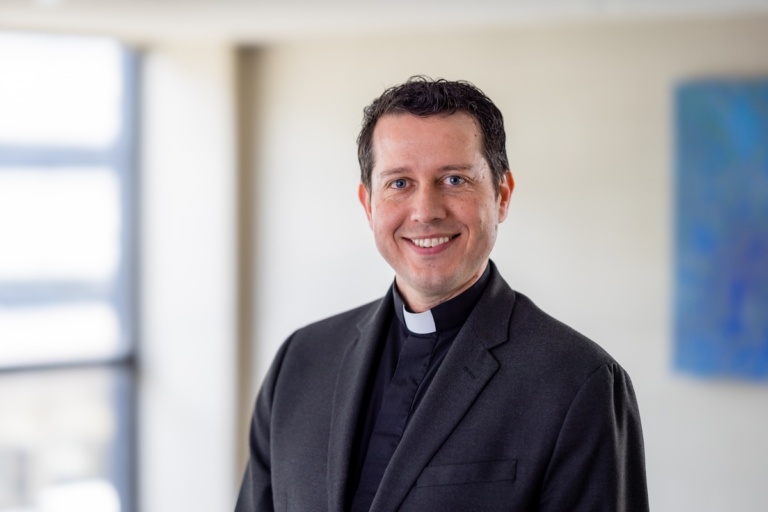
Portrait of Michael Rozier, S.J.

Michael Rozier, S.J.

Associate Professor, Healthcare Administration
Vice Provost for Strategic Initiatives

Contact: mrozier@luc.edu

School: Parkinson School of Health Sciences and Public Health

Expertise: Health, Religion

Focus Areas:

See Profile
  • Nonprofit health care
  • Public health ethics
  • Catholic health systems
  • Health policy