

The first Black woman to lead a Jesuit university honed her skills at Loyola
October 29, 2026
Share


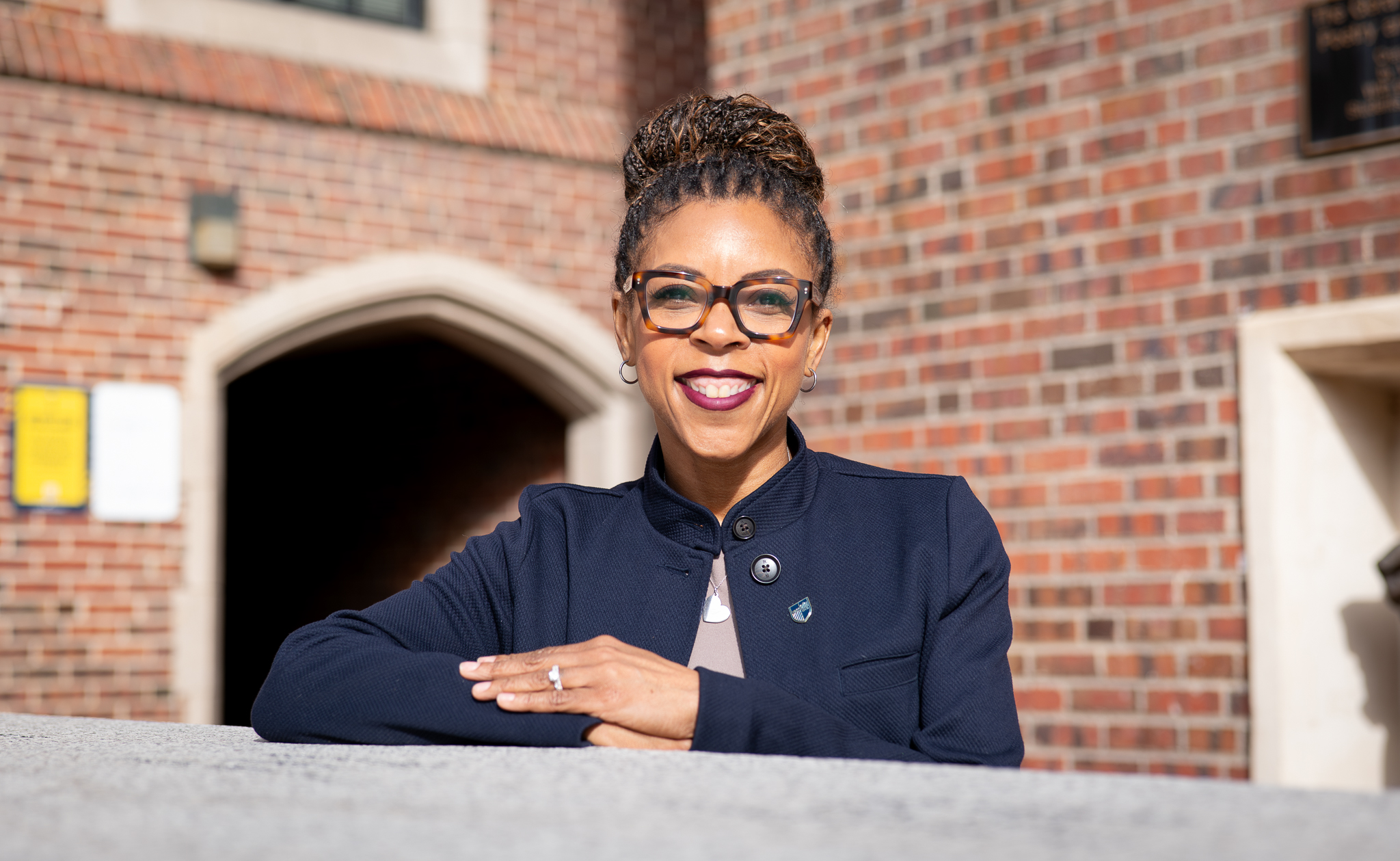
In September, Shawna Cooper Whitehead was inaugurated as president of Regis University, becoming the first Black woman to serve as a president of a Jesuit college or university in the United States.
Originally from Champaign-Urbana, Illinois, Cooper Whitehead cultivated her talents in higher education leadership at Loyola University Chicago, where she cumulatively served more than a decade in roles as assistant dean of the School of Communication and assistant provost of Student Academic Services.
Her expansive career, which began in an elementary school classroom at Dawes Elementary School in Evanston, and includes positions at Seton Hall, the University of Chicago, Northwestern University, the Massachusetts Institute of Technology, and Boston College, gives her a rare vantage into the mission and purpose of higher education.
At a time when universities are reckoning with a drop in the college-age population, federal funding cuts, and questions as to where artificial intelligence sits within the educational experience, her leadership is instructive. It reflects the enduring influence of her time at Loyola, and a service focus that unites the 28 member institutions of the Association of Jesuit Colleges and Universities (AJCU).
Loyola Today spoke with Cooper Whitehead about her time at Loyola, her vision for Regis’s future, and why she believes Jesuit universities are strongly positioned for the modern era.
In an interview with America magazine, you recalled an experience at Loyola when the student government took it upon themselves to vote to increase the student fee to support scholarships for undocumented students. Why did that moment have such a formative influence on your career?
Loyola was the first mission-driven institution that I had worked at. I’m Catholic, I was born and raised Catholic, and so I thought, “I can work at a Catholic school, no problem.” But I don’t know that I truly understood what that meant until I got to Loyola Chicago.
Back in 2008, Loyola had just opened the School of Communication. I worked on the academic side of the house as an assistant dean—doing academic advising, working on curriculum with the faculty, and making sure that the students were graduating. My maturation was really about learning the Jesuit history in that space. And what St. Ignatius and the Jesuits have always taught us is the importance of helping people on the margins.
And, for me, it was the fact that the Loyola students, the youth, if you will, did it themselves. They modeled an ethic of care for me. And it made me really think about ways in which I could contribute my gifts and talents in the service of others.
What did you learn in your roles at Loyola, and how did those experiences help you evolve as a leader in the higher education space?
The School of Communication had a tremendous faculty, but I also had a great mentor and supervisor, Don Heider, the school’s founding dean, who’s now a professor at Santa Clara. I tend to be a logistics person. How are we going to get this done? What’s the outcome? And he reminded me that there’s black and white and then there’s gray. Understanding the context, understanding the story, understanding individuals’ experiences to better relate to the human condition.
At Loyola Chicago, I was able to advise the Black Student Union for a short time. Back then, we were looking to improve the retention and persistence of our Black students. At a school of Loyola’s size, we were aiming to improve by 1 percent. That was 27 students. So what do we need to do? We love them up. We create a sense of belonging for our students. That also motivates them to help others and become great people in the world who contribute to a cause bigger than themselves.
This is a time of transition in higher education. Artificial intelligence is shifting the nature of the workforce. There’s also been a dip in the college-age population due to demographic changes.
How are Jesuit universities positioned to attract students in this moment? What do they offer, in your view, that a secular university or state school might not?
I think Pope Leo XIV laid it out really nicely in his encyclical letter, Magnifica Humanitas. AI is here. It might not be going anywhere, but it also is not going to take away from the humanistic experience that is fundamentally at the center of who our society is. And so there might be transactions and things that we can do faster, but it can’t have a dialogue like this. And that’s one of the things that Jesuit education does so well. It really encourages civil discourse and being with one another, the notion of accompaniment. AI can’t be at my side and give me a hug when I’m having a tough time.
With the challenges higher education is experiencing right now, Jesuit education has a really important place because it’s founded in the liberal arts. We’re not teaching students widgets or certain tasks. We’re teaching them to leverage their gifts and talents with additional knowledge that may change the context and provide a different way of facilitating conversations and bringing people to the table. That’s why our education is so distinctive.
I would also say that most, if not all, of our Jesuit schools are in major cities because we are here to serve. It’s a story I used to tell when I was at Loyola. I said, if you think about state schools, the flagship campus is normally, literally, in the geographical middle of a state. And that was intentional because, back in the day, the thought was we need to take students away from the temptations of a big city. And the Jesuits said, “No, we want to provide access to more people.”
Here at Regis, we are part of a network that participates in things like the Jesuit Prison Education Network (JPEN). We’re helping people on the margins, not just when it comes to race or gender or socioeconomic status. Folks who are incarcerated deserve education and access too. Father Tom Curran, S.J., who leads the effort on Regis’ campus, is a perfect example of that type of individual and why what we do is so distinctive. [Loyola hosted JPEN at the AJCU’s Faith, Justice and Reconciliation Assembly 2024: Creation of a Hope-filled Future, and several University academic departments collaborate on prison reform events, panels, and multi-year research studies alongside programs like the Illinois Prison Project].
You are the first woman to serve as president of Regis and the first Black woman to serve as president of a Jesuit college or university in the United States. Do you see yourself breaking a glass ceiling? And how does your identity shape your approach to leadership and campus diversity?
First, I think it’s a responsibility, in that I want to be really thoughtful about how I approach the role. I consider myself an inclusive leader, and I want to bring in other opinions. Not just diversity of race and gender, but diverse thoughts and values, to engage in exactly what we try to teach our students: civil discourse.
I’ve said this before, but I was the only Black girl in my class, kindergarten through eighth grade, at Holy Cross School in Champaign-Urbana. And one of the things that motivated me to do was to be an overachiever. I wanted to prove, “Hey, I’m smart, I can do things.” And even when I was an elementary school teacher, one of the things that I tried to do was make sure that all of my students understood the lessons. So I think carefully about how to speak to different types of audiences: doing this interview might be different than if I were speaking with faculty or talking to students.
My experience, particularly as a Black woman, is not a monolith. I had a pretty privileged background. I grew up with two amazing parents, a super supportive older brother and a middle-class family, and I know not everyone has access to education, not everyone has access to supportive individuals who cheer them on. And so, as a responsibility, part of what I feel is to let everyone know that every dream is a possibility; it’s about asking for help and not being afraid to be vulnerable and authentic.
With the challenges higher education is experiencing right now, Jesuit education has a really important place because it’s founded in the liberal arts.
— Shawna Cooper Whitehead, president of Regis University
You’ve had professional experiences at Loyola, Boston College, and Regis. Do you see continuity in terms of the Jesuit influence on the educational mission? And how are the schools different from one another?
I can start with Loyola being one of the largest Jesuit institutions. When I was there, there were roughly 17,000 students. On the flip side, Regis has just under 4,000 students. Loyola’s Water Tower campus is in the heart of the Magnificent Mile in the city. Both Boston College and Regis are in the city, but further out, not in the downtown area. And there are regional cultural differences.
On the flip side, there are a lot of similarities. Being of service is what I see as a common throughline. I would also say the faculty at all three of these institutions are just fabulous. They want to collaborate; they want to partner. That is one of the consistencies I’ve seen in Jesuit higher education. Because it’s a system, there are ways in which we can work together across our network, which is something very special. We have the luxury of having 28 of us in the AJCU that get together and learn from one another.
I think it’s fair to say you’ve had a lot of success in your career. What advice would you give to other aspiring higher education leaders?
I think people underestimate the value of relationships; the value of relationships with peers, the value of relationships with faculty, and the value of relationships with community members. I don’t just mean talking to the president or vice president. Understanding a culture, understanding individual needs, understanding group needs—all that begins through conversation. One of the many things I’ve learned across my career is that intentional relationship building matters. It’s not that I know more than anybody else. It’s that I really want to get to know people. And not just the people at the top—the custodians, the plant folks, the facilities folks. Everyone.


